Polycarbonate and PMMA Profiles

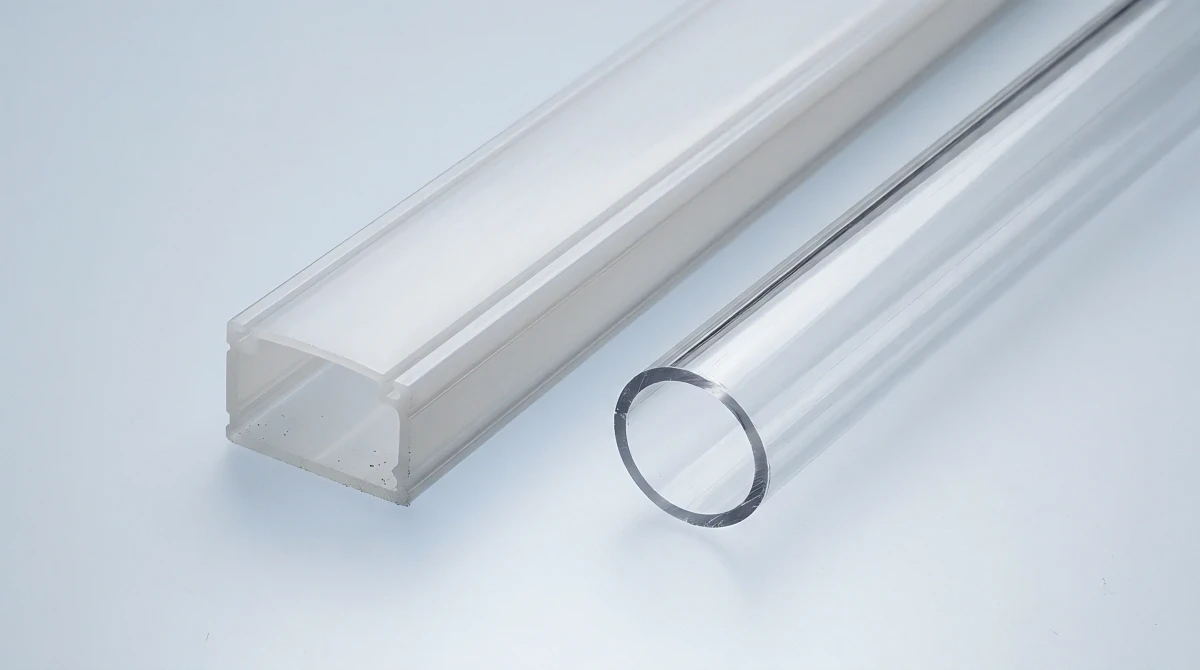
Polycarbonate and PMMA profiles are clear thermoplastic profiles, chosen for light transmission, whose length moves noticeably with heat and moisture.

Every Polycarbonate and PMMA Profiles article of the Profile Extrusion Resources, newest first, each written from published standards, research and makers’ data.

Meaning

Polycarbonate and PMMA profiles are clear thermoplastic profiles, chosen for light transmission, whose length moves noticeably with heat and moisture. A diffuser in a luminaire is a typical part. One maker, BWF, documents their tolerances, cutting and handling in detail, and their surface is judged by eye.

The Materials

Polycarbonate grades for profile extrusion are high in viscosity. LEXAN 135 has a melt volume-flow rate of 3.00 cm³/10 min, and Makrolon ET3113 has 6. Both list a tensile modulus of 2,350 MPa (341 ksi) and a heat deflection temperature of 128 °C (262 °F) at 1.8 MPa. Covestro gives 87 % light transmittance at 4 mm.
Read More

Tolerances

BWF applies DIN 16941 series 2A and 2B unless a drawing says otherwise. A 40 mm (1.57 in) width is held to ±0.8 mm (0.031 in). Walls run from ±0.2 mm on thin sections to ±8 % above 10 mm. These limits are roughly twice the aluminum values at the same sizes.

Thermal Growth

BWF gives both materials a thermal expansion of 0.7 mm per meter for every 10 °C. Impact-modified PMMA reaches 1.1 mm per meter. A 3 m (118 in) profile warmed from 20 to 50 °C grows about 6.3 mm (0.248 in). A profile fixed at both ends cannot grow, so it buckles or loads its fixings.

Cutting and Machining

BWF sets separate saw tolerances for offline and inline cuts. Precise lengths are measured on a table and show no crack, breakout or burr. The materials machine with most wood or metal tools, at speeds that avoid melting. Annealing after machining relieves the stress the cutting adds.

Handling

Soft PVC in seals or cable sleeves can pass plasticizer to the surface and cause stress cracking under clamping. A protective film on the visible side comes off within six months of delivery. Temperatures over 40 °C (104 °F) and UV can change its adhesive. For PMMA tubes, BWF’s stress test uses 90 % ethyl alcohol with 10 % distilled water.
Wall Thickness and Cross-Section Tolerance of Extruded Plastic Profiles

Read the nominal size row for each dimension, then check the fit as a sum of limits, not a single one.

Cross-Section Dimension Limits by Nominal SizeBWF's quality, tolerance and processing guidelines of 20 November 2024 apply limit values according to DIN 16941, series 2A and 2B, unless the drawing says otherwise. The general tolerances apply at any point of the profile cross-section, seen at right angles to the extrusion direction.

Cut Length and Saw Cut Tolerance of Extruded Profiles

A length tolerance belongs to a cutting step and a measuring method, so name both with the number.

Saw Tolerances for Plastic Profile LengthsBWF's guidelines of 20 November 2024 give saw tolerances for polycarbonate and PMMA profiles in two cases, offline cut and inline cut. Each is tabulated against the length, in millimeters, and each is tied to a method: lengths up to 4,500 mm are measured on a measuring table that checks length and angle, and longer ones with a measuring tape.

Polycarbonate Extruded Profile Properties and What the Datasheet Leaves Out

Read the resin sheet for viscosity, heat and growth, then ask what it leaves out about the profile itself.

What a Polycarbonate Datasheet States for Profile GradesTwo documents are read side by side here. SABIC's datasheet for LEXAN 135 resin describes the highest-viscosity linear polycarbonate powder in its range, and it names profile extrusion as the processing method.

Send the Section Drawing of Your Profile

Send the 2D drawing and the 3D file, with the quantity and the stage of the project. An engineer replies within 1 working day.

The quote form, the mutual NDA and the private folder for your files are on Protolis Atelier, with Profile Extrusion chosen.

Request a Quote