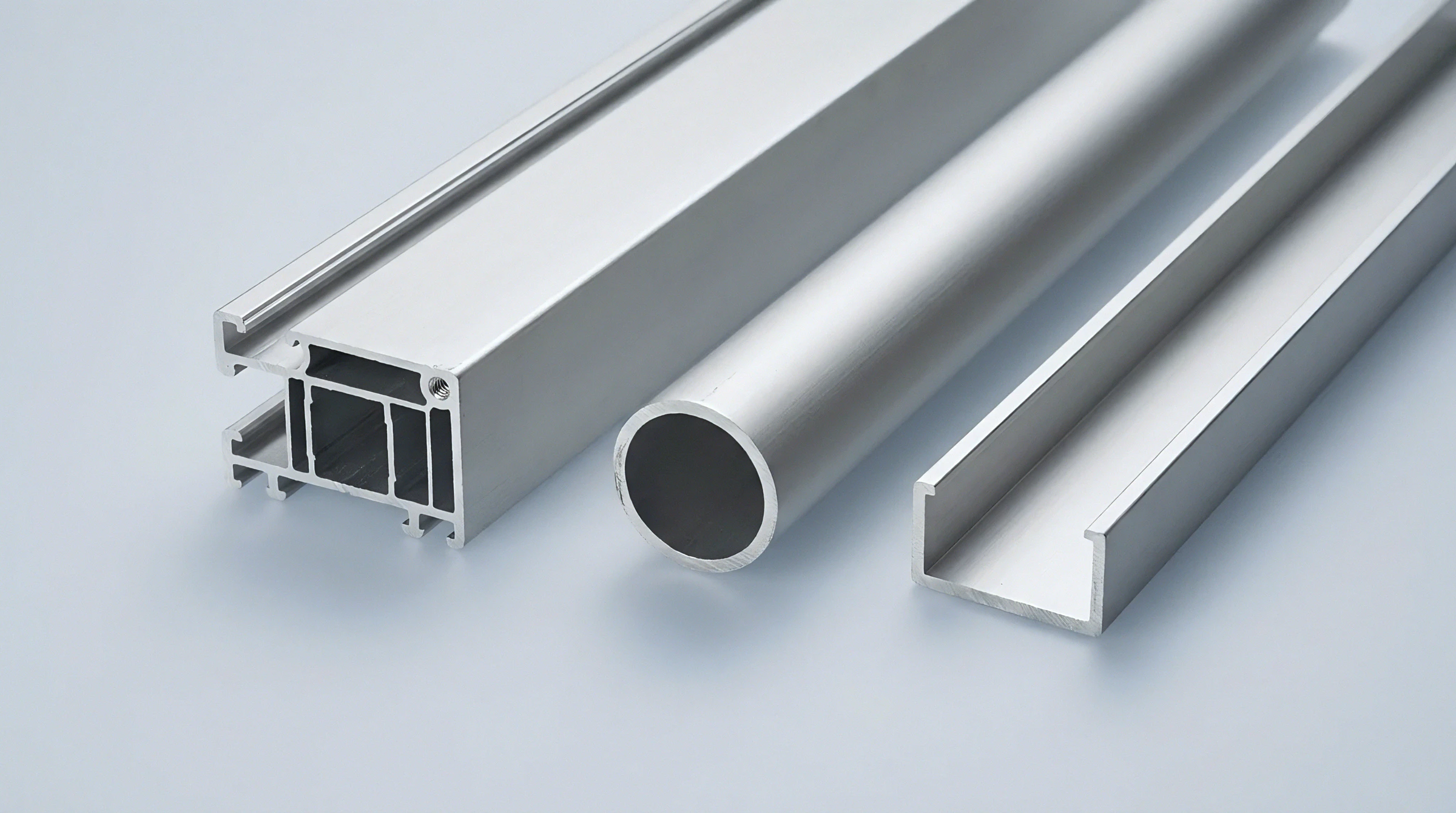
A 6063-T5 profile with a 9 mm wall is guaranteed 130 MPa of yield strength. Thicken that wall to 11 mm and the guarantee drops to 110 MPa. Hydro prints both figures in one table of its EN AW-6063 datasheet, and the drop comes from the way the profile is cooled at the press, not from anything on the drawing.
That small step explains most of what a buyer needs to know about 6063. The alloy is a soft, forgiving, anodizing-friendly extrusion grade, and its strength depends on a temper letter and a wall thickness more than on the alloy name. Each section below reads the maker’s table the way a purchasing engineer has to use it, with the conditions that travel with every number.
What EN AW-6063 Guarantees in T4, T5, T6 and T66
Hydro’s datasheet for EN AW-6063 (alloy designation AlMg0.7Si) lists minimum mechanical properties taken from EN 755-2:2016 for extruded profile. The values are minimums, and each row is tied to a wall thickness band. Hardness appears on the same sheet as a typical value for information only.
| Temper | Wall thickness t | Rp0.2 yield, min | Rm tensile, min | A elongation, min | A50 mm, min | Hardness, typical |
|---|---|---|---|---|---|---|
| T4 | t up to 25 mm (0.98 in) | 65 MPa (9.4 ksi) | 130 MPa (18.9 ksi) | 14 % | 12 % | 50 HBW |
| T5 | t up to 10 mm (0.39 in) | 130 MPa (18.9 ksi) | 175 MPa (25.4 ksi) | 8 % | 6 % | 65 HBW |
| T5 | over 10 to 25 mm | 110 MPa (16.0 ksi) | 160 MPa (23.2 ksi) | 7 % | 5 % | 65 HBW |
| T6 | t up to 10 mm | 170 MPa (24.7 ksi) | 215 MPa (31.2 ksi) | 8 % | 6 % | 75 HBW |
| T6 | over 10 to 25 mm | 160 MPa (23.2 ksi) | 195 MPa (28.3 ksi) | 8 % | 6 % | 75 HBW |
| T64 (bending quality) | t up to 15 mm (0.59 in) | 120 MPa (17.4 ksi) | 180 MPa (26.1 ksi) | 12 % | 10 % | 65 HBW |
| T66 | t up to 10 mm | 200 MPa (29.0 ksi) | 245 MPa (35.5 ksi) | 8 % | 6 % | 80 HBW |
| T66 | over 10 to 25 mm | 180 MPa (26.1 ksi) | 225 MPa (32.6 ksi) | 8 % | 6 % | 80 HBW |
Read down the yield column and the pattern is plain. T4 is the soft, naturally aged state. Both T5 and T6 roughly double its yield, and T66 pushes T6 up by another 30 MPa at the thin wall.
Every 6063 strength figure has three parts: the temper, the wall band and the word minimum. A quote that gives only “6063” has not told you which of the eight rows above applies.
Hydro marks T4, T6, T64 and T66 with a note that the properties may be obtained by press quenching. That note matters for the next section.
Hydro lists the composition limits of EN AW-6063 by weight percent according to EN 573-3:2013. Silicon runs from 0.20 to 0.60 and magnesium from 0.45 to 0.90, iron is capped at 0.35, and copper, manganese, chromium, zinc and titanium are each capped at 0.10. The sheet adds that Hydro’s internal limits are tighter, with different variants made to deliver T6 and T66 properties. A T66 line on an order is therefore a statement about one producer’s variant and its process, as well as about the standard.
How the Temper Letters Differ
Hydro’s sheet defines the tempers by EN 515:1993 in plain terms. T5 is cooled from an elevated-temperature shaping process and then artificially aged. In T6 the profile is solution heat treated and then artificially aged. T4 is solution heat treated and naturally aged, T64 is aged in underageing conditions between T6 and T61 to improve formability, and T66 is a T6 with a higher property level reached through special control of the process.
The practical meaning is in the first words. A T5 profile gets its strength from the heat it carries out of the die and from the age-hardening oven that follows. Its T6 counterpart has been through a solution step of its own, which is why the datasheet footnotes allow press quenching to reach it on this alloy.
For the buyer the difference shows up in three places:
- the guaranteed yield at the same wall, 130 MPa for T5 against 170 MPa for T6 up to 10 mm;
- the sensitivity to wall thickness, which is a step of 20 MPa in T5 and only 10 MPa in T6 at the 10 mm boundary;
- the hardness reading, typically 65 HBW for T5 and 75 HBW for T6.
A bending shop cares about T64 for a different reason. The datasheet marks T64 as bending quality, with 12 % elongation against 8 % for T6, in exchange for 120 MPa yield instead of 170.
Why a Thicker Wall Lowers the Guarantee
The table splits at 10 mm in T5, T6 and T66, and again at 15 mm for the T64 row. Inside a band the figure is the same, outside it the minimum steps down. The datasheet’s third footnote adds the rule that matters on a real cross-section.
If a profile cross-section has walls that fall in more than one band, the lowest specified value counts for the whole profile.
So a heat-sink with 3 mm fins on a 12 mm base is graded on the 12 mm base. In T6 that means 160 MPa yield and 195 MPa tensile for the whole part, not the 170 and 215 of its fins. The rule is a feature of how the standard certifies a profile, so it shows up on the mill certificate even when the fins carry the load.
When a design needs the higher T6 line, keep the thickest wall at or under 10 mm, or accept the lower line as the figure for the whole part.
6063 Next to 6060 and the Surface Question
Hydro’s datasheet says 6063 has been increasingly replaced by 6060, with equal strength but improved surface finish. The 6060 sheet from the same maker lists lower minimums in the table, so the sentence and the table do not describe the same comparison.
At the 10 to 25 mm band in T6, EN AW-6063 is guaranteed 160 MPa yield and 195 MPa tensile. EN AW-6060 in T6 for 5 to 25 mm is guaranteed 140 MPa and 170 MPa. At 5 mm and under, 6060-T6 is guaranteed 150 MPa and 190 MPa, against a 6063 band that runs up to 10 mm and gives 170 and 215.
The two alloys also differ in their composition limits, which is where the difference in character starts. Hydro lists 6063 at 0.20 to 0.60 % silicon and 0.45 to 0.90 % magnesium, with iron up to 0.35 %. The 6060 sheet gives 0.30 to 0.60 % silicon, 0.35 to 0.60 % magnesium and a tighter iron window of 0.10 to 0.30 %.
Hydro’s relative grading table, on a scale where 5 is the top grade, puts both alloys at 5 for decorative anodizing and for corrosion resistance. Surface finish grades 5 for 6060 and 4 for 6063, tensile strength grades 1 for 6060 and 2 for 6063, and machinability grades 2 for 6060 and 3 for 6063.
Where the visible surface decides the part, the maker’s own grading favors 6060. Where the guaranteed strength decides it, the maker’s table favors 6063.
Set against the structural alloys on the same maker’s sheets, 6063 sits low. For T6 in an open profile with a wall of 5 mm or less, the guaranteed yield is 170 MPa for 6063 (its band runs to 10 mm), 225 MPa for 6005A and 250 MPa for 6082. Stiffness does not follow the strength: the modulus is 69 GPa for 6063 and 70 GPa for both structural alloys. A stronger alloy resists yielding better and deflects about the same under the same load, since deflection depends on stiffness and not on yield.
The North American Limits for 6063 as a Second Reading
A buyer sourcing in inches meets a different table. The Aluminum Association publishes mechanical property limits for extruded profiles in ksi, and the copy opened for this piece is the May 2009 reprint of Aluminum Standards and Data. It uses thickness bands in inches and carries its own temper rows, so its figures are a separate set and not a restatement of Hydro’s.
| Temper | Specified thickness | Tensile, min | Yield, min | Elongation in 2 in. or 4D, min |
|---|---|---|---|---|
| T4 and T42 | 12.7 mm (up to 0.500 in) | 131 MPa (19.0 ksi) | 69 MPa (10.0 ksi) | 14 % |
| T5 | 12.7 mm (up to 0.500 in) | 152 MPa (22.0 ksi) | 110 MPa (16.0 ksi) | 8 % |
| T5 | 12.7 to 25.4 mm (0.501 to 1.000 in) | 145 MPa (21.0 ksi) | 103 MPa (15.0 ksi) | 8 % |
| T6 and T62 | 3.1 mm (up to 0.124 in) | 207 MPa (30.0 ksi) | 172 MPa (25.0 ksi) | 8 % |
| T6 and T62 | 3.2 to 25.4 mm (0.125 to 1.000 in) | 207 MPa (30.0 ksi) | 172 MPa (25.0 ksi) | 10 % |
Two things stand out when the sets sit side by side. The T5 yield limit of 110 MPa (16.0 ksi) for walls up to 12.7 mm matches the 110 MPa that Hydro gives for T5 between 10 and 25 mm, and the T6 yield of 172 MPa (25.0 ksi) is close to Hydro’s 170 MPa for walls up to 10 mm.
Another point is the split in the thickness bands. The North American table breaks T5 at 12.7 mm (0.500 in) and T6 at 3.1 mm (0.124 in), while the European table breaks both at 10 mm, so a wall of 11 mm falls in one table’s thin band and the other table’s thick band. That is why a drawing needs to name which standard governs, not only which alloy.
The two tables are close in their T5 and T6 yield lines, and they are not interchangeable. A certificate written to one standard does not prove the other.
The same Aluminum Association table also lists a T52 temper for 6063, with a tensile range of 152 to 207 MPa (22.0 to 30.0 ksi) and a yield range of 110 to 172 MPa (16.0 to 25.0 ksi) for sections up to 25.4 mm (1.000 in). Per a footnote, 6063-T52 is a producer temper and an exception to the ANSI H35.1 temper designation paragraphs. A temper with a maximum as well as a minimum asks the profile to stay inside a band, which is a different request from being strong enough.
Physical Properties of 6063
Hydro gives its physical data as typical values at room temperature, 20 °C, from a Swedish handbook reference. The elevated-temperature curves on the same sheet are marked for information only and not as guaranteed properties.
| Property | Value | Note |
|---|---|---|
| Density | 2.70 g/cm³ (0.0975 lb/in³) | all tempers |
| Modulus of elasticity | 69 GPa (10.0 Msi) | all tempers |
| Modulus of rigidity | 26 GPa (3.8 Msi) | all tempers |
| Melting range | 615 to 655 °C (1,139 to 1,211 °F) | all tempers |
| Thermal conductivity | 201 W/m·K (116 BTU/h·ft·°F) | T6 |
| Specific heat capacity | 901 J/kg·K (0.215 BTU/lb·°F) | all tempers |
| Electrical resistivity | 35 nΩ·m (35 × 10⁻⁹ Ω·m) | T6 |
| Linear expansion | 23.5 × 10⁻⁶ /K (13.1 × 10⁻⁶ /°F) | all tempers |
The conductivity row explains the heat-sink entry in the maker’s list of applications. A heat-sink extrusion asks the alloy to carry heat from its base into thin fins, and 201 W/m·K in T6 is the number that decides how far that works.
On the sheets of the structural alloys, Hydro gives 172 W/m·K for 6082-T6 and 176 W/m·K for 6005A-T6, so 6063-T6 at 201 W/m·K is the better conductor of the three.
The expansion row has a use of its own. At 23.5 × 10⁻⁶ /K, a 6 m length grows by about 1.4 mm for every 10 °C of temperature rise, a figure to remember when a long profile is fixed at both ends.
Where the Maker’s Sheet Stops
A datasheet is a statement about the alloy and the temper. It is silent about several things a buyer needs before ordering a specific profile, and the reader has to ask for them.
- The wall thicknesses of the actual cross-section, since the band that governs is the thickest.
- The temper actually ordered, written as T5, T6, T64 or T66, since the table above spans 65 to 200 MPa of guaranteed yield between rows.
- The hardness check, which the maker says is for information only, so no hardness is guaranteed by the table.
- Whether the profile is open or hollow. Hydro’s 6082 and 6005A sheets split their rows that way, and the 6063 sheet does not, so a hollow 6063 section is read from the same rows as an open one.
- Fatigue behavior. Hydro prints one example curve for 6063-T6, tested at 20 ± 2 °C on flat specimens parallel to the extrusion direction at load ratio R = 0.1 and 2 million cycles, and marks it as not guaranteed.
The fatigue note carries its own conditions. A flat specimen cut along the extrusion direction does not say how a welded or machined corner of a particular profile behaves.
Cutting and Machining 6063 Lengths
The relative grading puts machinability of 6063 at 3 and cold-forming at 5, with weldability at 5. A grade of 3 on a scale where 5 is best reads as workable, not as free-cutting, which is the plain meaning of the number.
A cut length from a press is a length of constant section, and the cut itself leaves the ends square to a tolerance that the standard tables cover separately. Machining after cutting removes material from a profile that has its own straightness and twist limits, so the machined feature is datumed from the surface that the profile tolerance controls. The tolerance pieces in these resources read those limits in detail.
Anodizing is the usual reason to choose 6063 or 6060 over a structural alloy. The decorative anodizing grade of 5 is shared by both, so the choice between them rests on the earlier strength and surface lines.
What to Put on the Order for 6063
An order that names the alloy, temper and wall band reads the same on the mill certificate as on the drawing. The list below is the short form.
- Alloy and standard, written as EN AW-6063 to EN 755-2, or the equivalent national designation your supplier uses.
- Temper, T5 or T6 as a rule, T66 when the higher line is needed and the wall allows it, T64 when the profile will be bent.
- Thickest wall in millimeters, so the right band governs the certificate.
- Finish, anodized or coated, because that decides whether 6063 or 6060 is the better alloy.
- Whether the supplier may press quench to reach T6, since the datasheet notes it can be obtained that way.
When a few hundred lengths are needed before a production die and a final temper are settled, low-volume profile extrusion and bridge production are the two places to ask how many lengths the first run should carry.
Sources and Further Reading
- The Aluminum Association, Aluminum Standards and Data, Table 11.1 mechanical property limits, extruded wire, rod, bar and profiles, May 2009 reprint
- Hydro, Technical datasheet, extruded products, alloy EN AW-6063 [AlMg0.7Si], Rev. 4, 03/2023
- Hydro, Technical datasheet, extruded products, alloy EN AW-6060 [AlMgSi], Rev. 4, 03/2023
- Hydro, Technical datasheet, extruded products, alloy EN AW-6082 [AlSi1MgMn], Rev. 4, 03/2023
- Hydro, Technical datasheet, extruded products, alloy EN AW-6005A [AlSiMg(A)], Rev. 4, 03/2023