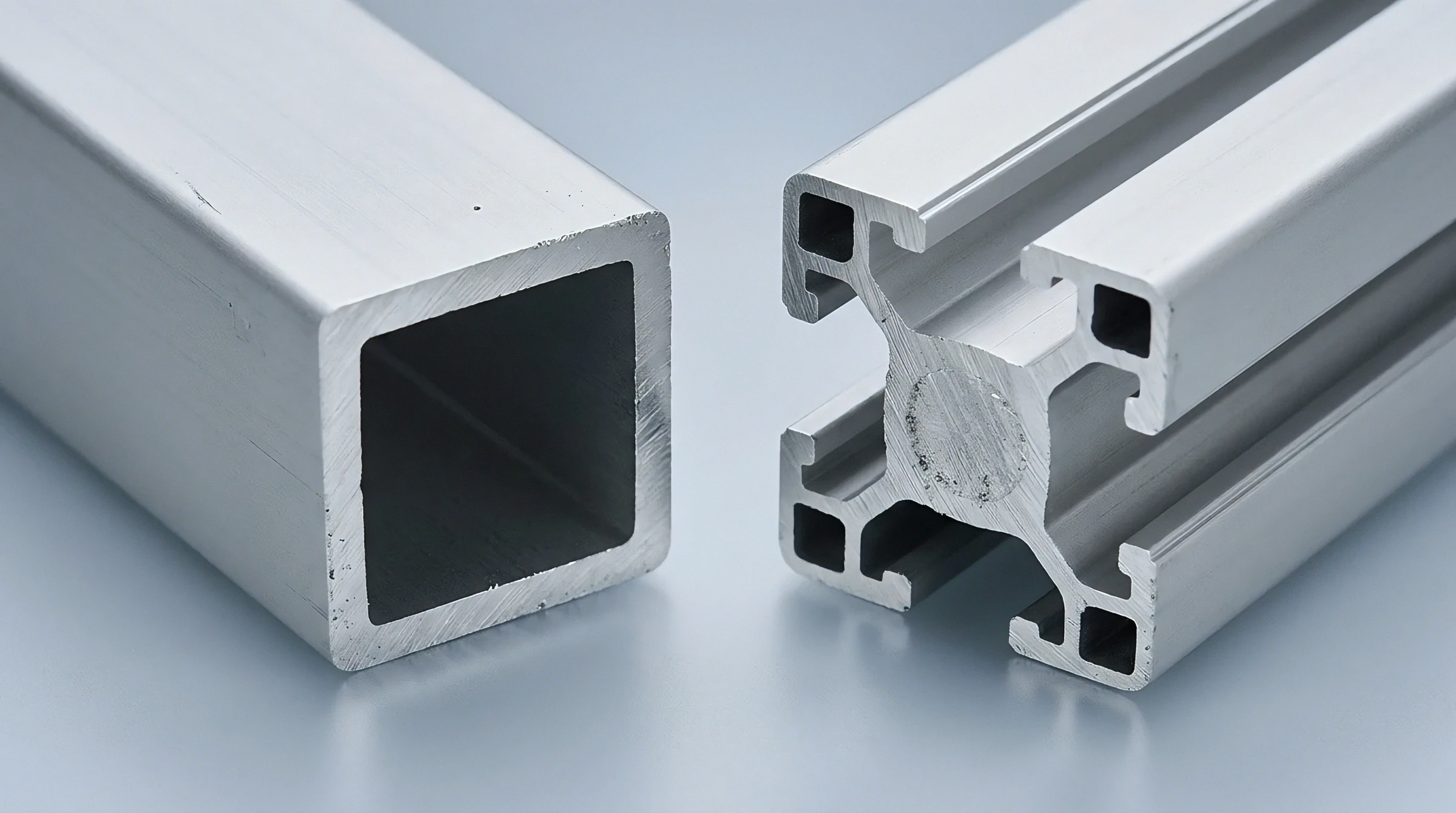
Hydro’s EN AW-6082 datasheet guarantees 250 MPa of yield strength in T6 for an open profile with a wall of 5 mm or less, and 260 MPa for a wall between 5 and 25 mm. The thicker band carries the higher figure. A buyer who has learned from 6063 that thicker walls lose strength finds the opposite on this sheet, and the first reaction is to doubt the table.
The table is right, and the sheet has to be read on its own terms. Structural 6000-series alloys, 6082 and 6005A, are the ones chosen when a profile carries load, and each of them has its own pattern of bands, tempers and special variants. This piece reads both sheets row by row and sets them beside the Aluminum Association’s North American limits.
What the 6082 and 6005A Datasheets Guarantee
Hydro prints minimum mechanical properties for each alloy, taken from EN 755-2:2016 for extruded profile. Both sheets split their rows into open and hollow profiles, which the 6063 sheet does not. Hardness is given as a typical value for information, and the Vickers figure is converted from Brinell and called approximate.
| Alloy and temper | Profile and wall thickness t | Rp0.2 yield, min | Rm tensile, min | A, min | A50 mm, min |
|---|---|---|---|---|---|
| 6082-T4 | t up to 25 mm (0.98 in) | 110 MPa (16.0 ksi) | 205 MPa (29.7 ksi) | 14 % | 12 % |
| 6082-T5 | open, t up to 5 mm (0.20 in) | 230 MPa (33.4 ksi) | 270 MPa (39.2 ksi) | 8 % | 6 % |
| 6082-T5 | hollow, t up to 5 mm | 230 MPa (33.4 ksi) | 270 MPa (39.2 ksi) | 8 % | 6 % |
| 6082-T6 | open, t up to 5 mm | 250 MPa (36.3 ksi) | 290 MPa (42.1 ksi) | 8 % | 6 % |
| 6082-T6 | open, 5 to 25 mm | 260 MPa (37.7 ksi) | 310 MPa (45.0 ksi) | 10 % | 8 % |
| 6082-T6 | hollow, t up to 5 mm | 250 MPa (36.3 ksi) | 290 MPa (42.1 ksi) | 8 % | 6 % |
| 6082-T6 | hollow, 5 to 15 mm (0.59 in) | 260 MPa (37.7 ksi) | 310 MPa (45.0 ksi) | 10 % | 8 % |
| 6005A-T4 | open, t up to 25 mm; hollow, t up to 10 mm | 90 MPa (13.1 ksi) | 180 MPa (26.1 ksi) | 15 % | 13 % |
| 6005A-T6 | open, t up to 5 mm | 225 MPa (32.6 ksi) | 270 MPa (39.2 ksi) | 8 % | 6 % |
| 6005A-T6 | open, 5 to 10 mm | 215 MPa (31.2 ksi) | 260 MPa (37.7 ksi) | 8 % | 6 % |
| 6005A-T6 | open, 10 to 25 mm | 200 MPa (29.0 ksi) | 250 MPa (36.3 ksi) | 8 % | 6 % |
| 6005A-T6 | hollow, t up to 5 mm | 215 MPa (31.2 ksi) | 255 MPa (37.0 ksi) | 8 % | 6 % |
| 6005A-T6 | hollow, 5 to 15 mm | 200 MPa (29.0 ksi) | 250 MPa (36.3 ksi) | 8 % | 6 % |
The 6005A sheet lists T4 and T6 only. A purchaser looking for a 6005A T5 line on the Hydro sheet will not find one there.
At the same 5 mm wall, 6082-T6 is guaranteed 250 MPa yield and 6005A-T6 is guaranteed 225 MPa in an open profile, a gap of 25 MPa, while 6082 reaches 260 MPa on thicker walls and 6005A falls to 200 MPa.
Hydro also lists special variants of 6082 on a separate line, with the note to contact the local supplier. Hollow T64 is given as 250 MPa yield and 325 MPa tensile with 15 % elongation, and T66 for all walls as 320 MPa yield and 340 MPa tensile with 8 % elongation (A) and 6 % (A50 mm). Those two lines are offers of a particular producer and sit outside the standard rows.
Why a Thicker 6082 Wall Can Carry a Higher Guarantee
The sheet is a record of what the standard allows each band, and the 6082 bands run upward with thickness in T6. Open profiles split at 5 mm and hollow profiles split at 5 mm as well, with the hollow upper band ending at 15 mm and the open upper band at 25 mm.
For 6005A the numbers run the other way, down with thickness, in three open steps at 5 and 10 mm and two hollow steps at 5 mm. The structural reader should keep both patterns in mind and read the band that matches the thickest wall of the actual cross-section, as the third footnote on both sheets says.
The Hydro footnote repeats the rule found on the 6063 sheet. If the cross-section has walls in more than one band, the lowest specified value is the one that holds for the whole profile. For 6082-T6 that is the 250 MPa line, because a section mixing 3 mm and 12 mm walls is graded on the lower figure.
The footnote about mixed thicknesses removes the benefit of the 260 MPa band for a profile that also has a thin wall. The 250 MPa line governs the whole section.
Composition Limits That Set the Two Alloys Apart
Hydro lists composition limits by weight percent according to EN 573-3:2013, and says on the 6082 sheet that its internal limits are tighter. The differences between the alloys sit mainly in silicon, magnesium and manganese.
- EN AW-6082: silicon 0.70 to 1.30 %, magnesium 0.60 to 1.20 %, manganese 0.40 to 1.00 %, iron up to 0.50 %, chromium up to 0.25 %.
- EN AW-6005A: silicon 0.50 to 0.90 %, magnesium 0.40 to 0.70 %, iron up to 0.35 %, chromium up to 0.30 %, with manganese plus chromium held to 0.12 to 0.50 % by a footnote on the sheet.
- EN AW-6063, for comparison: silicon 0.20 to 0.60 %, magnesium 0.45 to 0.90 %, manganese up to 0.10 %.
6082 carries roughly twice the silicon of 6063, plus a manganese range that 6063 does not have. Hydro’s own text on the 6082 sheet says the manganese is added to increase toughness and makes the alloy less suitable for decorative anodizing.
How 6005A Sits Between 6063 and 6082
Hydro prints a relative grading of related alloys from a 1989 Swedish handbook, with 5 as the top grade. It places 6005A in the middle on most lines and 6082 at the strong end.
| Property | 6060 | 6063 | 6005 | 6005A | 6082 |
|---|---|---|---|---|---|
| Tensile strength | 1 | 2 | 3 | 3 | 4 |
| Impact strength | 2 | 2 | 1 | 3 | 4 |
| Surface finish | 5 | 4 | 3 | 3 | 2 |
| Suitability for decorative anodizing | 5 | 5 | 4 | 3 | 2 |
| Corrosion resistance | 5 | 5 | 4 | 4 | 4 |
| Machinability | 2 | 3 | 4 | 4 | 5 |
| Cold forming | 5 | 5 | 4 | 4 | 3 |
| Weldability | 5 | 5 | 5 | 5 | 4 |
The table reads as a trade. Moving from 6060 to 6082 gains strength grade from 1 to 4 and machinability from 2 to 5, and loses surface finish from 5 to 2, anodizing suitability from 5 to 2 and cold forming from 5 to 3.
A structural profile that will be painted or hidden loses little from those lower grades. For a visible rail with a decorative anodized face, 6082 is a poor home.
Where the profile carries load and its face is covered, 6082 and 6005A lead the table. Where the face is seen and anodized, the two stand at the bottom of the anodizing line.
Physical Properties of Both Alloys
Hydro gives typical physical data at room temperature, 20 °C. The values are close to 6063 on density and stiffness and differ on melting range and conductivity.
- Modulus of elasticity: 70 GPa (10.2 Msi) for both 6082 and 6005A. Modulus of rigidity: 26 GPa (3.8 Msi).
- Density: 2.71 g/cm³ (0.098 lb/in³) for both alloys.
- Melting range: 575 to 650 °C (1,067 to 1,202 °F) for 6082, and 605 to 655 °C (1,121 to 1,211 °F) for 6005A.
- Thermal conductivity: 150 W/m·K in T4 and 172 W/m·K in T6 for 6082; 176 W/m·K in T6 for 6005A (172 and 176 W/m·K are 99 and 102 BTU/h·ft·°F).
- Linear expansion: 23.1 × 10⁻⁶ /K for 6082 and 23.3 × 10⁻⁶ /K for 6005A (about 12.8 and 12.9 × 10⁻⁶ /°F).
A frame that mixes 6082 with a steel part sees the expansion difference first. Over a 3 m aluminum length the change is about 0.7 mm for every 10 °C of temperature change, which is the figure to put against the slot size in a connection.
Set beside 6063 on the sibling sheet, the physical lines move very little. Stiffness is 70 GPa (10.2 Msi) for 6082 and 6005A against 69 GPa (10.0 Msi) for 6063, and density is 2.71 against 2.70 g/cm³. Yield moves a great deal, from 170 MPa for 6063-T6 up to 10 mm to 250 MPa for 6082-T6 up to 5 mm, a rise of about 47 %. Conductivity moves the other way, from 201 W/m·K for 6063-T6 to 172 W/m·K for 6082-T6, a fall of about 14 %.
The lesson for a designer is that switching to 6082 adds load capacity before yield, gives up thermal and surface performance, and adds no stiffness. A part limited by deflection gains nothing from the change.
The temper matters as much as the alloy. In T4 the 6082 sheet guarantees 110 MPa yield and 205 MPa tensile with 14 % elongation for walls up to 25 mm, and in T6 between 5 and 25 mm it guarantees 260 and 310 MPa with 10 %. Artificial aging takes the guaranteed yield up by a factor of about 2.4.
The North American Limits for 6005A and 6082
The Aluminum Association’s May 2009 reprint of Aluminum Standards and Data carries mechanical property limits for extruded profiles in ksi. It is a separate document from the European sheets and uses inch thickness bands.
| Alloy and temper | Specified thickness | Tensile, min | Yield, min | Elongation, min |
|---|---|---|---|---|
| 6005A-T1 | 6.3 mm (up to 0.249 in) | 172 MPa (25.0 ksi) | 100 MPa (14.5 ksi) | 15 % |
| 6005A-T5 | up to 0.249 in | 262 MPa (38.0 ksi) | 214 MPa (31.0 ksi) | 7 % |
| 6005A-T5 | 6.4 to 25.4 mm (0.250 to 0.999 in) | 262 MPa (38.0 ksi) | 214 MPa (31.0 ksi) | 9 % |
| 6005A-T61 | up to 0.249 in | 262 MPa (38.0 ksi) | 241 MPa (35.0 ksi) | 8 % |
| 6005A-T61 | 0.250 to 1.000 in | 262 MPa (38.0 ksi) | 241 MPa (35.0 ksi) | 10 % |
| 6082-T6, T6511 | 5.1 to 19.1 mm (0.200 to 0.750 in) | 310 MPa (45.0 ksi) | 262 MPa (38.0 ksi) | 6 % |
| 6082-T6, T6511 | 19.1 to 152 mm (0.751 to 6.000 in) | 310 MPa (45.0 ksi) | 262 MPa (38.0 ksi) | 8 % |
| 6082-T6, T6511 | 152 to 203 mm (6.001 to 8.000 in) | 283 MPa (41.0 ksi) | 241 MPa (35.0 ksi) | 6 % |
The second table has a different reach from the first. Its 6082 rows run to 8 inches of thickness, far beyond the 25 mm of the Hydro rows, and its 6005A has T5 and T61 where the Hydro sheet gives T4 and T6.
The reader should also note the temper names. T6511 is a stress-relieved temper, one of the TX511 group that the Aluminum Association tolerance tables name as stress relieved, so a drawing that says 6082-T6511 asks for that kind of profile and not for plain T6.
Reading a Worked Cross-Section Against the Bands
A hollow rectangular tube in 6082-T6 with 4 mm side walls and a 6 mm web has walls in two Hydro bands, up to 5 mm and 5 to 15 mm. The lowest line governs, so the whole tube is graded at 250 MPa yield and 290 MPa tensile, not the 260 and 310 of the thicker band.
Remove the 6 mm web, make every wall 4 mm, and the grade stays at 250 and 290. Thicken every wall to 6 mm and the whole section moves to 260 and 310 MPa.
The same exercise in 6005A runs the other way. A hollow section with 4 mm walls and a 6 mm web falls to the 5 to 15 mm band at 200 MPa yield and 250 MPa tensile, a drop of 15 MPa and 5 MPa from the thin-wall line.
A designer who adds a thicker rib to a 6005A profile lowers the guaranteed figure for the whole section. A designer who adds one to a 6082 profile leaves the figure at the thin-wall line, and only a section with every wall in the upper band reaches the higher one.
What the Maker Lists as Typical Uses
Hydro describes 6082 as a medium-strength alloy with higher strength than 6005A. Its sheet lists structural beams, bumper rails, scaffolding and train floors as typical applications, and its text adds seat rails and valve blocks.
The 6005A sheet calls the alloy a medium-strength structural alloy with a good combination of strength, toughness and surface finish, more suitable than 6082 for decorative anodizing. Its sheet lists structural elements, boat masts and railway applications, and its text names yacht masts, train carriages, running boards for SUVs and complex sections for railway, bus and truck structures.
The two lists overlap on rail and transport, and they separate on finish. A part that will be seen and anodized falls to 6005A by the maker’s own wording, and a part that carries the highest load in the family falls to 6082.
Cutting, Machining and Welding
Hydro’s grading puts machinability at 4 for 6005A and 5 for 6082, with 5 the top grade in that row. Weldability grades 5 for 6005A and 4 for 6082, so a welded structure leans toward the former and a machined block toward the latter.
For a profile cut to length, that grading has a plain meaning in the workshop. A saw cut across 6082 meets a harder, stronger section than one across 6063, and the end squareness the tolerance tables allow is stated independently of alloy.
A welded joint is a place where the guaranteed strength of the profile does not apply, since the heat of welding changes the temper. This is a fact about the temper definitions, not a figure from the sheets, and the datasheets do not print welded-joint strengths. Ask the profile supplier or the fabricator for the weld values rather than reading across from the table.
Writing the Order for a Structural Profile
The order line for a structural profile carries more than the alloy. A short checklist keeps the certificate and the drawing in agreement.
- Alloy designation with its standard, for example EN AW-6082 to EN 755-2, or the national designation that your inspector will recognize.
- Temper, T6 for most load-carrying work, with T5 asked for only where the sheet lists it for that alloy.
- Open or hollow, since the bands differ by profile type on both sheets.
- Thickest wall, since the lowest specified value governs the whole section when walls span two bands.
- Whether the face is seen, which decides whether the surface and anodizing grades of the two alloys matter.
When the load case is proven on a first run of a few hundred lengths and the die is still open to change, low-volume profile extrusion and bridge production are the places to ask how the first lengths should be cut, tempered and inspected.
Sources and Further Reading
- Hydro, Technical datasheet, extruded products, alloy EN AW-6082 [AlSi1MgMn], Rev. 4, 03/2023
- Hydro, Technical datasheet, extruded products, alloy EN AW-6005A [AlSiMg(A)], Rev. 4, 03/2023
- Hydro, Technical datasheet, extruded products, alloy EN AW-6063 [AlMg0.7Si], Rev. 4, 03/2023
- Hydro, Technical datasheet, extruded products, alloy EN AW-6060 [AlMgSi], Rev. 4, 03/2023
- The Aluminum Association, Aluminum Standards and Data, Table 11.1 mechanical property limits, extruded wire, rod, bar and profiles, May 2009 reprint
- The Aluminum Association, Aluminum Standards and Data, Tables 11.5 to 11.14 standard tolerances, extruded wire, rod, bar and profiles, May 2009 reprint