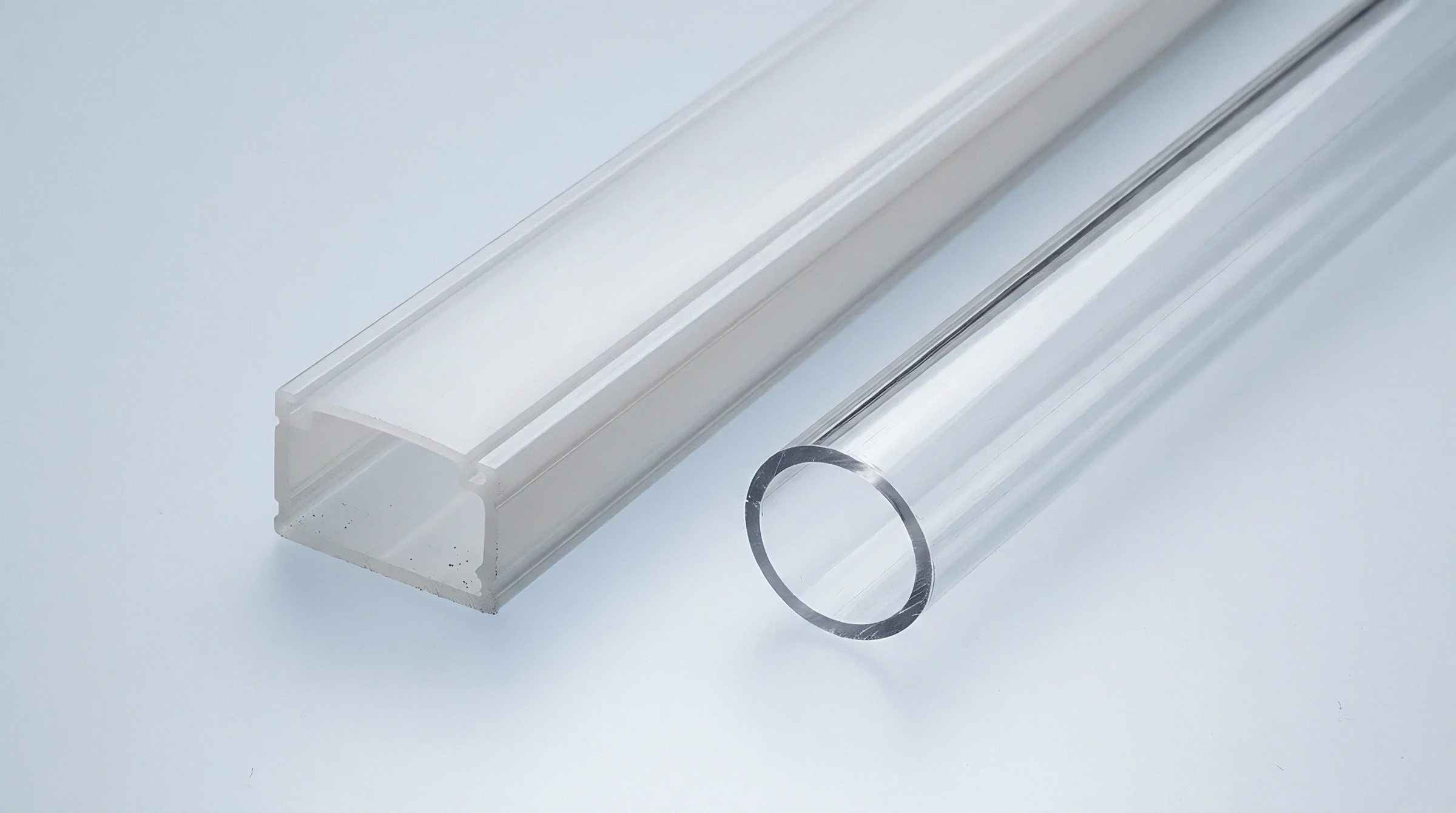
A 3 m polycarbonate profile that moves from a 20 °C workshop into a 50 °C luminaire grows by about 6 mm. The figure follows from 0.7 mm of growth per meter for every 10 °C, which the profile maker BWF prints in its processing guidelines for polycarbonate and PMMA, and from nothing more exotic than arithmetic. A buyer who reads only the strength line of a datasheet meets the 6 mm at assembly.
Polycarbonate is chosen for extruded profiles because it is clear, tough and stable to about 128 °C under load. The datasheets that make that case are written for the resin, and the part is a profile. This piece reads two makers’ sheets for the properties that matter to a profile buyer and then lists what the sheets do not say.
What a Polycarbonate Datasheet States for Profile Grades
Two documents are read side by side here. SABIC’s datasheet for LEXAN 135 resin describes the highest-viscosity linear polycarbonate powder in its range, and it names profile extrusion as the processing method. Covestro’s page for Makrolon ET3113 describes a high-viscosity polycarbonate granule with a melt volume-flow rate of 6.0 cm³/10 min, UV stabilized and available in transparent colors only.
The first document is hosted as a copy by a distributor that disclaims liability and advises checking values with the supplier. Covestro’s page is the maker’s own. Where a figure matters, the piece names which one gave it.
| Property | LEXAN 135 | Makrolon ET3113 | Test method |
|---|---|---|---|
| Density | 1.20 g/cm³ (0.0434 lb/in³) | 1,200 kg/m³ (0.0434 lb/in³) | ISO 1183 |
| Melt volume-flow rate, 300 °C / 1.2 kg | 3.00 cm³/10 min | 6 cm³/10 min | ISO 1133 |
| Tensile modulus | 2,350 MPa (341 ksi) | 2,350 MPa (341 ksi), 1 mm/min | ISO 527 |
| Yield stress | 63.0 MPa (9.1 ksi) | 65 MPa (9.4 ksi), 50 mm/min | ISO 527 |
| Stress at break | 70.0 MPa (10.2 ksi) | 70 MPa (10.2 ksi) | ISO 527 |
| Strain at break | 120 % | 130 % | ISO 527 |
| Flexural modulus | 2,300 MPa (334 ksi) | 2,350 MPa (341 ksi) | ISO 178 |
| Heat deflection temperature, 1.8 MPa | 128 °C (262 °F) | 128 °C (262 °F) | ISO 75 |
| Vicat softening temperature | 144 °C (291 °F), B50; 145 °C (293 °F), B120 | 148 °C (298 °F), 50 °C/h; 149 °C (300 °F), 120 °C/h | ISO 306 |
| Linear thermal expansion | 7.0 × 10⁻⁵ /°C, 23 to 80 °C (3.9 × 10⁻⁵ /°F) | 0.65 × 10⁻⁴ /K, 23 to 55 °C (3.6 × 10⁻⁵ /°F) | ISO 11359 |
| Water absorption at equilibrium, 23 °C, 50 % RH | 0.15 % | 0.12 % | ISO 62 |
| Water absorption at saturation, 23 °C | 0.35 % | 0.3 % | ISO 62 |
The two grades agree on the main lines. Modulus is 2,350 MPa on both, tensile stress at break 70 MPa on both, and heat deflection temperature 128 °C at 1.8 MPa on both.
A polycarbonate profile is stiff to about 2.3 GPa, holds its shape under load to about 128 °C, and moves 0.65 to 0.70 parts in 10,000 per degree. Those three lines decide most designs before any special grade is considered.
Covestro’s page adds lines the other sheet does not carry. The glass transition temperature is 148 °C, luminous transmittance is 87 % at 4 mm and 89 % at 1 and 2 mm, haze is 0 to 0.8 % at 3 mm, and the refractive index is 1.587. Burning behavior is HB at 1.5 mm and V-2 at 0.75 mm on the UL 94 scale.
Covestro also prints impact, creep and electrical values.
Notched Izod impact strength is 70 kJ/m² at 23 °C and 20 kJ/m² at -30 °C on 3 mm specimens, and Charpy notched impact is 80 and 18 kJ/m². Puncture energy is 60 J at 23 °C and 70 J at -30 °C. The tensile creep modulus is 2,200 MPa (319 ksi) after 1 hour and 1,900 MPa (276 ksi) after 1,000 hours, a fall of about 14 %. Volume resistivity is 1 × 10¹⁴ Ω·m and electric strength is 34 kV/mm at 1 mm.
The notched impact figures fall by a factor of 3.5 to 4.4 between 23 °C and -30 °C, so a profile that sees cold weather has less margin than the room-temperature number suggests. For any profile held under a steady load, the creep line matters, such as a clip or a clamped lens, since stiffness after 1,000 hours is what the part carries.
Why Viscosity Is the Extrusion Property
The MVR line in the table is the one that separates an extrusion grade from a molding grade. A lower melt volume-flow rate means a stiffer melt, and the 3.00 cm³/10 min of LEXAN 135 sits at half the 6 cm³/10 min of Makrolon ET3113. SABIC describes the former as the highest-viscosity linear polycarbonate powder type, suitable for extrusion processes.
A stiff melt matters for a profile because the strand leaves the die with only its own viscosity to hold the shape until the calibrator and the cooling bath take over. Thin-flowing melt sags, and a stiff one keeps the corners and the ribs the die cut.
The reading rule for the buyer is plain. Makers state the melt flow rate at 300 °C under a 1.2 kg load, so two grades are comparable only when both sheets give the same test condition.
Extrusion Conditions Printed for LEXAN 135
SABIC lists a full set of processing temperatures for the powder grade. They are the maker’s recommendation for the grade and do not describe any particular supplier’s line.
| Setting | Value |
|---|---|
| Drying temperature | 120 °C (248 °F) |
| Drying time | 2.0 to 4.0 h |
| Hopper temperature | 40 to 60 °C (104 to 140 °F) |
| Cylinder zones 1 to 4 | 260 to 280 °C (500 to 536 °F) |
| Adapter temperature | 260 to 280 °C (500 to 536 °F) |
| Melt temperature | 270 to 280 °C (518 to 536 °F) |
| Die temperature | 250 to 260 °C (482 to 500 °F) |
| First calibration temperature | 70 to 90 °C (158 to 194 °F) |
The die runs 20 °C cooler than the melt, and the calibrator at 70 to 90 °C is where the profile takes its final size. A tolerance question for a polycarbonate profile is partly a calibration question.
The drying line is the most commonly missed one in a quotation. Polycarbonate absorbs water, and the same sheet gives 0.15 % at equilibrium in 23 °C air at 50 % relative humidity and 0.35 % at saturation in water.
Moisture, and What It Does to a Profile
A water uptake of 0.15 % sounds small, and the sheet still lists 2 to 4 hours of drying at 120 °C before processing. Drying takes the water out before the resin is melted.
After extrusion, moisture changes the length of the finished profile. BWF states that plastic profiles, sheets and tubes absorb moisture depending on storage and ambient conditions, and that the absorption can affect length as well as processability. If different faces of a profile sit in different conditions, the guidelines say uneven dimensional changes can occur, with waves and bulges as examples.
BWF’s reference conditions for length and tolerance data are 20 °C and 30 % relative humidity, and the storage advice is a flat base at 20 °C and about 50 % humidity. Those are the conditions under which a measured length can be compared with a drawing.
A length quoted without a temperature and a humidity is incomplete. Polycarbonate shifts with both, and the supplier’s reference conditions say which day the number was true.
Heat, Growth and the Limits of the Heat Rating
The 128 °C in the table is a heat deflection temperature measured on a 120 × 10 × 4 mm bar under a 1.8 MPa bending stress. It describes a stiffness loss on a test bar, not a continuous service rating for any profile.
Vicat softening at 144 to 149 °C and the 148 °C glass transition give a further view of where the material softens. A polycarbonate profile bonded or clipped near a hot component is judged by the lower of those figures and by the stress it carries, not by the melting behavior of the powder.
Growth is the effect that shows up first. BWF gives the thermal expansion of PMMA and polycarbonate as 0.7 mm per meter for a 10 °C change, with impact-resistant PMMA up to 1.1 mm per meter. The two polycarbonate coefficients in Table 1 give 0.70 mm per meter for LEXAN 135 (7.0 × 10⁻⁵ /°C over 10 °C) and 0.65 mm per meter for Makrolon ET3113.
| Length | Rise to 30 °C (10 °C) | Rise to 50 °C (30 °C) | Rise to 70 °C (50 °C) |
|---|---|---|---|
| 1 m (39.4 in) | 0.7 mm (0.028 in) | 2.1 mm (0.083 in) | 3.5 mm (0.138 in) |
| 3 m (118 in) | 2.1 mm (0.083 in) | 6.3 mm (0.248 in) | 10.5 mm (0.413 in) |
| 6 m (236 in) | 4.2 mm (0.165 in) | 12.6 mm (0.496 in) | 21.0 mm (0.827 in) |
The table is a linear calculation and assumes a free profile. A profile held at both ends by a rigid fixing does not grow, and it buckles or loads the fixing instead.
Stress, Annealing and Chemical Contact
BWF says its extruded profiles have a low degree of internal stress, and that even low stresses can show up as dimensional change when the profile is sawn, milled, drilled, bonded, painted or heated. It recommends annealing after machining to relieve the stress that the machining adds.
The guidelines also give a chemical warning. Soft PVC next to polycarbonate or PMMA, in rubber coatings or cable insulation for example, can pass plasticizer to the surface at higher temperature, and BWF says that lowers tensile strength and can lead to stress cracking, especially under clamping load. For tubes, BWF runs a standard stress test at the start of production, once per shift and when production parameters change, and for PMMA the test liquid is 90 % ethyl alcohol with 10 % distilled water.
For a luminaire or an enclosure, the practical content of that warning is a list of what touches the profile:
- the rubber or soft PVC seals, which are the usual source of plasticizer;
- the cable sleeves and ballast parts, which warm up in service and can release volatile constituents that BWF says may reduce tensile strength;
- the clips and screws that load the profile, since BWF links stress cracking to external clamping force;
- the adhesives and paints, which BWF lists among the steps that need a stress-relieved profile first.
Surface, Color and Inclusions in a Clear Profile
A clear profile is judged by eye, and BWF describes how it does that. The visible surface is inspected from about 1 m, lit and unlit, for 10 seconds per meter of profile. Obvious inclusions, scratches from mechanical damage and extrusion lines that the extrusion process does not cause are not allowed.
Inclusions are counted against a template. For BWF’s standard materials the guideline allows up to 5 inclusions in total on a reference weight of 1 kg of profile, made up of at most 3 of 0.2 mm², 2 of 0.5 mm² and 1 of 0.8 mm². BWF treats its figures as stricter than the specifications it derives them from for extruded sheet.
Color is released against a strip approved by the customer, by a visual comparison in reflected and transmitted light, and the allowed deviation is ΔE of 3 or less. The check is made in the customer’s installation situation or, if that is not available, with the customer’s illuminant.
Two handling points follow from the same document. A protective film is applied to the visible side and BWF asks that it be removed no later than six months after delivery and that the profile be kept out of direct sunlight, because temperatures above 40 °C and UV can change the adhesive. The film also has to come off before vacuum forming, and peeling it can leave a static charge that draws dust. A clear profile often meets molded parts at its ends: the end caps and clips that close a polycarbonate tube or light cover are usually injection molded in the same polymer family, and matching their color and clarity to the extruded length is a question for both suppliers.
For a clear polycarbonate profile the surface limit, the color limit and the film age are all agreed numbers. Ask for them on the drawing with the grade.
What the Datasheet Leaves Out
Three limits of a resin datasheet matter to a profile buyer, and the sheets themselves state two of them.
- The specimens are not profiles. Covestro’s processing conditions for its test specimens are injection molding at a 300 °C melt and an 80 °C mold with 200 mm/s injection velocity. SABIC’s note says the datasheet values are typical of what the powder gives when converted into extruded products. Neither sheet gives properties of a specific cross-section, so wall thickness, ribs and cooling are not in the numbers.
- The grade is not the compound. Color, UV stabilization and additives change the line. Covestro’s ET3113 is UV stabilized and clear only, and a pigmented profile is a different compound with its own sheet.
- The test is not the use. The heat deflection value belongs to a 4 mm bar. A thin-wall hollow profile and a thick solid bar of the same grade do not respond the same way to the same load.
The third limit is not stated on either sheet and follows from how the numbers were measured. A buyer who needs a property that the datasheet gives only as a typical value asks for a test report on the profile or a sample cut from it.
Cutting and Machining Polycarbonate Lengths
BWF says polycarbonate and PMMA profiles can usually be machined with most tools used on wood or metal. The guidance on speed, cutting edge and cooling is direct.
- Choose tool speeds so the material does not melt from friction, since plastic has poor thermal conductivity.
- Keep cutting tools sharp.
- Cool the tool, for example with directed airflow, and test any cooling lubricant for chemical resistance with the plastic first.
BWF also prints tolerances for machined parts, from ±0.3 mm up to 50 mm of size to ±4.0 mm above 4,000 mm, and says annealing after machining reduces the stress that sawing and milling add. The same guidelines distinguish precise lengths from multiple lengths. Precise lengths are measured on a measuring table and a saw cut is allowed no visible cracks, breakouts or burrs, while multiple lengths carry a tolerance of plus 20 mm and are cut afterward. The numbers for each case are read in the cut-length piece of these resources.
When a profile in polycarbonate is settled and a few hundred finished lengths are wanted before a production die is justified, low-volume profile extrusion and bridge production are the two places to ask how the first run should be dried, extruded, cut and inspected.
Sources and Further Reading
- SABIC Innovative Plastics Europe, LEXAN 135 resin, polycarbonate, datasheet (copy hosted by Shanghai Susheng)
- Covestro, Makrolon ET3113, polycarbonate, product page with typical values
- BWF Kunststoffe GmbH & Co. KG, Quality, tolerance and processing guidelines for products made by BWF Kunststoffe, 20 November 2024