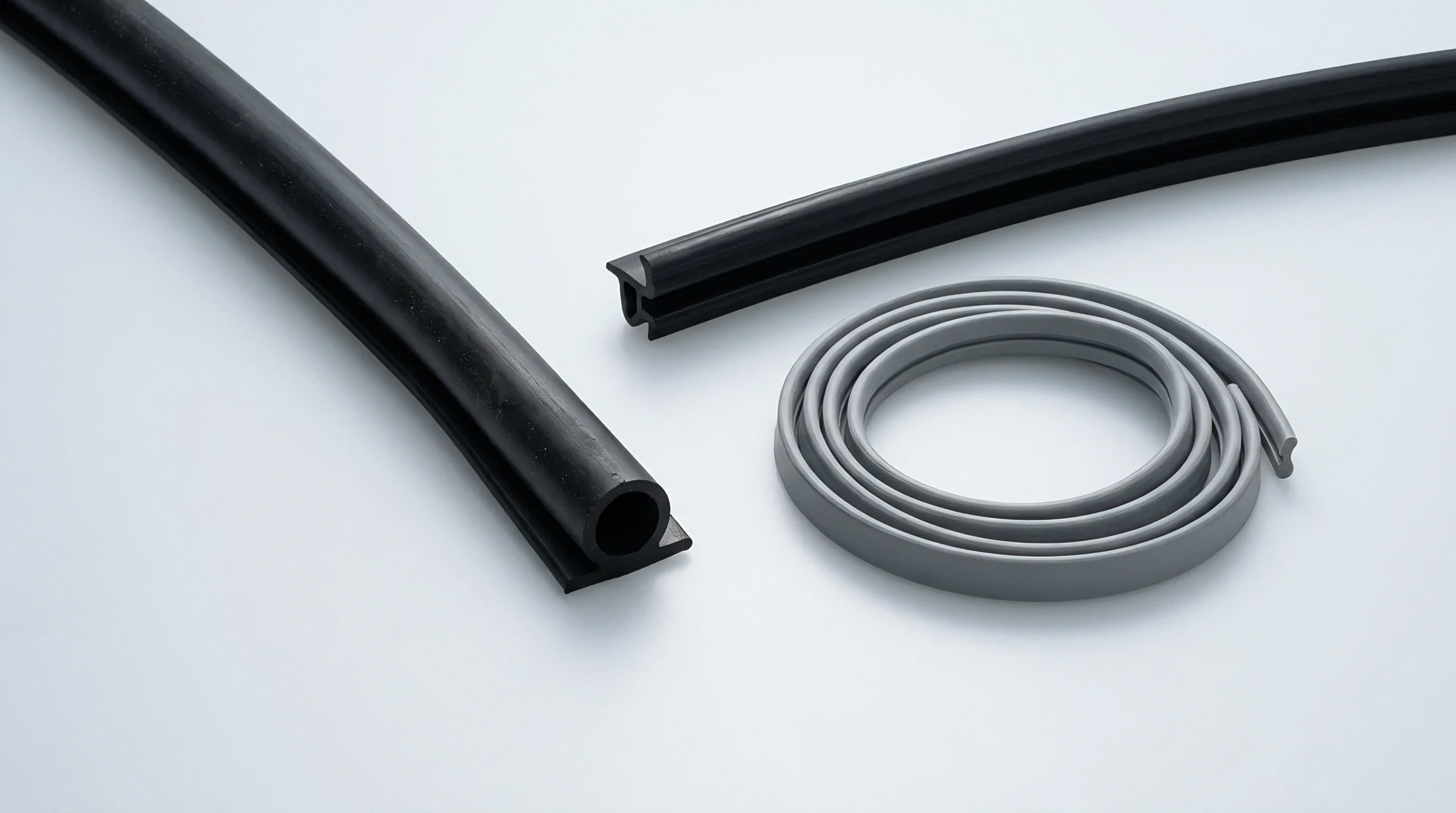
Test strips of one TPV grade can disagree by half depending on how they are cut. Teknor Apex’s datasheet for Sarlink TPV 5775B gives a tensile stress at 100 % strain of 4.90 MPa (711 psi) along the flow direction and 3.20 MPa (464 psi) across it. The same sheet lists a hardness of 72 Shore A on extruded material and 75 on injection-molded material. A seal compound has no single stiffness, and the numbers that describe it carry the direction, the process and the test with them.
Seals and gaskets are where profile extrusion meets elastomers. The materials that dominate the soft side of window, door and appliance profiles are thermoplastic: flexible PVC, styrenic TPE and thermoplastic vulcanizate. This article reads them through makers’ datasheets and selection guides, with attention to how stiffness, recovery and heat are actually stated.
Flexible PVC, TPE-S and TPV for Extruded Seals
HEXPOL TPE offers three families for profile extrusion, soft PVC, TPS and TPV, in hardnesses from 20 Shore A to 60 Shore D. Its list of profile uses covers window and door profiles, waterstops, keder profiles, automotive weather seals, train profiles, furniture edges and the door seals of refrigerators and washing machines. Elastron, a TPE compounder, describes its construction grades as based on TPV and SEBS compounds and lists glazing seals, sash seals, frame seals, door seals and pipe joint gaskets among their uses.
What these materials share is that they melt. Elastron’s brochure defines thermoplastic elastomers as rubber-like materials that, unlike vulcanized rubber, can be processed and recycled like thermoplastics without curing. HEXPOL draws the practical consequences:
- scrap and offcuts can be re-melted and recycled in a closed loop;
- no crosslinking step is needed, so processing takes less energy;
- the soft material can be co-extruded with a thermoplastic substrate in one die.
Flexible PVC sits beside them. Teknor Apex describes its Flexalloy PVC elastomers as extending flexible PVC with improved abrasion resistance, chemical and oil resistance, low-temperature flexibility, compression set resistance and quick spring-back, processed on standard PVC equipment. For window and door profiles, its Apex 2310UV2 and 2316UV2 flexible PVC compounds come in a Shore A range of 60 to 80 and are formulated to co-extrude onto rigid vinyl.
The soft side of an extruded seal is usually a thermoplastic: flexible PVC, a styrenic TPE or a TPV. Each melts, welds and recycles, and each states its properties differently.
Hardness, Density and Service Range by TPE Family
Elastron’s comparison of its three product lines shows how the chemistry sets the limits before any grade is chosen. Its G line is SEBS/PP based, its V line is a crosslinked TPV, and its D line is SBS/PP based.
| Property | G line, SEBS/PP TPE | V line, crosslinked TPV | D line, SBS/PP TPE |
|---|---|---|---|
| Hardness range | 12 Shore A to 65 Shore D | 30 Shore A to 65 Shore D | 20 Shore A to 65 Shore D |
| Density, minimum | 0.88 g/cm3 (0.032 lb/in3) | 0.90 g/cm3 (0.033 lb/in3) | 0.89 g/cm3 (0.032 lb/in3) |
| Compression set | good | very good | medium |
| Elasticity | high | very high | medium |
| Service temperature | -50 to 120 °C (-58 to 248 °F) | -50 to 135 °C (-58 to 275 °F) | -50 to 70 °C (-58 to 158 °F) |
| UV resistance | good | good | poor |
| Bonds to, standard grades | PP, PE, EVA | PP, PE, EVA | PP, PE, EVA |
The table separates the outdoor seal materials from the rest. Its SBS-based line stops at 70 °C (158 °F) and has poor UV resistance, while the SEBS and TPV lines reach 120 and 135 °C (248 and 275 °F) with good UV resistance. The crosslinked TPV leads on compression set and elasticity, which is why Elastron builds its weatherseal grades on it and on SEBS.
Hardness is the first number on any seal drawing, and it is the least fundamental. ASTM D2240, the durometer test method, covers twelve types of durometer from OO to D and states that indentation hardness depends on the material’s elastic modulus and viscoelastic behavior. It also says that there is no simple relationship between readings from different durometer types, and that the test is empirical and intended mainly for control. Teknor Apex’s TPE selection worksheet adds that TPEs can be measured on the Shore OO, A or D scales, from a soft gel to something as hard as polypropylene.
On an extruded seal the hardness works through the section. A hollow bulb with a thin wall closes under a far lighter load than a solid cord of the same compound. The cross-section drawing, with its wall thickness and whether the bulb is hollow or solid, sets the closing force as much as the Shore figure does.
Stiffness of a Seal Compound and the Modulus Behind It
For a rigid plastic, stiffness is a modulus of elasticity read from the start of a stress-strain curve. Elastomer datasheets rarely print that number. They give tensile stress at a stated elongation, usually 100 % and sometimes 300 %, measured to ASTM D412 or ISO 37. Elastron labels this row “modulus of 100 % elasticity”, and Teknor Apex labels it “tensile stress at 100 % strain”; both describe the stress needed to stretch the test piece to twice its length.
On a seal profile that stiffness acts through the section: a thin-walled bulb bends where a solid cord compresses, so one compound gives a soft seal in one section and a firm one in another.
| Property | Sarlink TPV 5775B | Sarlink TPV 5780B | Sarlink TPV 5750DB | Elastron V251.A75.B |
|---|---|---|---|---|
| Hardness, extruded | 72 Shore A | 80 Shore A | 49 Shore D | 75 Shore A, 3 s |
| Stress at 100 %, across flow | 3.20 MPa (464 psi) | 4.50 MPa (653 psi) | 13.1 MPa (1,900 psi) | 3.20 MPa (464 psi), direction not stated |
| Stress at 100 %, along flow | 4.90 MPa (711 psi) | 6.80 MPa (986 psi) | 18.0 MPa (2,611 psi) | not stated |
| Tensile at break, across flow | 8.50 MPa (1,233 psi) | 10.0 MPa (1,450 psi) | 23.0 MPa (3,336 psi) | 8.00 MPa (1,160 psi) |
| Elongation at break, across / along | 590 % / 340 % | 590 % / 360 % | 640 % / 490 % | 600 % |
| Compression set, 23 °C (73 °F), 22 h | 23 % | 28 % | 55 % | 20 % |
| Compression set, 70 °C (158 °F), 22 h | 32 % | 41 % | 67 % | 38 % |
| Compression set, hotter | 47 % at 125 °C (257 °F), 70 h | 60 % at 125 °C, 70 h | 85 % at 125 °C, 70 h | 50 % at 100 °C (212 °F), 22 h |
| Density | 0.970 g/cm3 (0.035 lb/in3) | 0.970 g/cm3 | 0.960 g/cm3 | 0.96 g/cm3 |
| Test basis | ISO 37, ISO 815, ISO 868 | ISO 37, ISO 815, ISO 868 | ISO 37, ISO 815, ISO 868 | ASTM D412, D395, D2240 |
Three readings follow from the table. First, the flow direction stiffens the test strips: the along-flow stress at 100 % is about 1.5 times the across-flow value for 5775B and 5780B and about 1.4 times for 5750DB. The datasheets report this on test pieces cut along and across the flow, so a datasheet value without a direction is an incomplete number. On an extruded seal the flow runs along the length of the profile, and Elastron’s V251.A75.B shows the same split in shrinkage, 2.25 % along the flow and 1.10 % across it on its ASTM D955 test pieces.
Second, hardness alone does not fix the stiffness. Moving from 72 to 80 Shore A raises the across-flow stress at 100 % from 3.20 to 4.50 MPa, about 40 %. Yet Elastron’s V251.A75.B at 75 Shore A prints the same 3.20 MPa as the 72 Shore A 5775B. A drawing that names hardness alone leaves the load to compress the seal section open.
For a seal, hardness is a control number and stress at 100 % strain is the stiffness. Ask for both, with the direction of the test strip.
Compression Set and Heat in an Extruded Seal
An extruded seal is a continuous section, pressed along its whole length against a frame or a sash, and it has to recover the same way after years of closing. A gasket that does not spring back stops sealing. Compression set measures that loss: the share of a compression that remains after the load is removed, after a set time at a set temperature. The datasheet figures come from standard test pieces, while the seal recovers through its own section. A thin-walled hollow bulb and a solid cord of the same compound recover differently in the frame, and the cross-section drawing is where that wall is fixed. Teknor Apex’s worksheet says plainly that compression set requirements determine which TPE family to choose, and Trelleborg lists compression requirements beside temperature range, UV exposure and chemical compatibility as the bases of material selection.
The datasheets show how fast compression set grows with heat. Sarlink TPV 5775B holds 23 % at room temperature, 32 % after 22 hours at 70 °C (158 °F) and 47 % after 70 hours at 125 °C (257 °F). Its harder sibling 5780B reads 28, 41 and 60 % at the same conditions, and the 49 Shore D grade 5750DB reads 55, 67 and 85 %. Hardness and recovery pull in opposite directions in this series.
Heat ageing tells the rest. Teknor Apex reports for 5780B that tensile strength across the flow changes by -10 % after 1,000 hours at 135 °C (275 °F) in air, and for 5750DB by -20 %, with elongation falling by 30 %. A seal near a heat source is chosen on those rows as well as on compression set. These are the limits a thermoplastic accepts in exchange for being extruded, welded and recycled. The extruded seal is the choice for long lengths cut to size and joined at hot plate welded corners. The order states the cut length and the corner joints with the section.
Teknor Apex’s worksheet frames the environment as a set of questions to answer before a family is picked: the minimum and maximum constant use temperature and the time spent at extremes, exposure to UV or severe weather, whether a chemical only splashes the part or submerges it, at what temperature, and whether the part sits under load or is flexed and stretched repeatedly. Each answer narrows the family before any single grade is compared.
Die Swell and Drawdown on a Soft Seal Section
A seal profile leaves the die larger than it ends up. Every thermoplastic swells as it exits the die lip, and Dan Cykana’s column on profile die design in Plastics Technology sets out how the die is drawn to allow for it. The land, the straight run of steel that gives the profile its shape, offsets that swell and gives the section its memory. For equal walls the column suggests a land of about ten times the wall thickness, so a 2.5 mm (0.10 in) wall runs on a land of about 25 mm (1 in).
The die is also cut larger than the part by a drawdown, the percentage the extrudate is pulled down between die and sizing so that it stays taut instead of sagging. The column gives 15 to 30 percent for flexible PVC, against 4 to 10 percent for rigid PVC, on a 2.5 in extruder at 100 to 125 lb/h. The extrudate keeps drawing down until it has cooled through its glass transition or heat distortion temperature, so a soft lip that leaves the cooling tank too warm keeps shrinking toward a smaller section than the drawing asked for.
Two practical points follow for a seal. A die cut for one compound is not a die for another, because each polymer has its own drawdown, so a change from flexible PVC to a TPV is a die question as well as a material one. And the soft lip and the stiff carrier of a co-extruded seal draw down by different amounts, which is one reason the first run of profile, not the drawing, shows whether the section fits its groove.
Flexible PVC Seals and Co-Extrusion on Rigid Profiles
Flexible PVC is the soft material that bonds most naturally to a rigid PVC frame. Teknor Apex describes its Apex 2310UV2 and 2316UV2 series as forming cohesive bonds with rigid vinyl when co-extruded, which means that in bond tests the flexible PVC itself tears before the interface does. Pre-drying the flexible compound helps bond strength, the company notes, while its formulation aims to make that step unnecessary. The series is UV resistant and can be supplied with fungicide.
TPEs bond to their own partners. Elastron lists PP, PE and EVA for standard grades, and offers bondable grades for polar plastics such as ABS, PC and PA. Its construction grades are designed for dual and tri-durometer extrusions combining rigid, soft and ultra-soft components, can be foamed for weight reduction, and are joined at corners by hot plate welding. HEXPOL lists co-extrusion with thermoplastic substrates and weldability among the benefits of its extrusion grades.
Window seals bring appearance requirements of their own. Elastron lists, for its window profile and door seal grades, no staining on the profile, resistance to gas fade discoloration and supply in natural, black or pre-colored form, and it names the approvals some of its grades carry: RAL-GZ 716/1 and CSTB QB36 for window profile seals, and EN 681-2, type WT, hardness class 60, for elastomeric pipe joint seals in water and drainage. Its flame-retardant grades are listed to UL 94 V0 at 1.5 and 3 mm (0.06 and 0.12 in). An approval of this kind belongs to the named grade and its maker; a seal extruded from another compound does not inherit it.
Two cautions apply to flexible PVC as a material. Vicat softening, the heat figure common on rigid datasheets, is not a fit test for it: ASTM D1525 states the method is not recommended for nonrigid PVC. And the flexible compound carries the processing limits of PVC itself, which the Flexalloy guide sets out.
| Hardness | Barrel settings | Die settings | Melt temperature |
|---|---|---|---|
| 35 to 50 Shore A | 121 to 154 °C (250 to 310 °F) | 154 to 160 °C (310 to 320 °F) | 168 to 174 °C (335 to 345 °F) |
| 50 to 60 Shore A | 132 to 166 °C (270 to 330 °F) | 160 to 171 °C (320 to 340 °F) | 174 to 179 °C (345 to 355 °F) |
| 60 to 70 Shore A | 138 to 171 °C (280 to 340 °F) | 171 to 174 °C (340 to 345 °F) | 179 to 185 °C (355 to 365 °F) |
The same guide sets the rest of the line: a 20:1 to 24:1 L/D screw with a 2:1 to 3:1 compression ratio, 20/40 stainless screens, at least 30 rpm, a cold water bath of 4 to 16 °C (40 to 60 °F), up to 20 % regrind, and a melt never above 204 °C (400 °F). Drying is not normally needed, though 4 hours at 71 °C (160 °F) may help co-extrusion, which matches the bond advice for the Apex co-extrusion grades.
What a Seal Drawing and Order Should State
The makers’ documents point to a short list that turns a seal drawing into a specification a supplier can quote and test against:
- The material family and grade, or the approval the grade has to carry, such as RAL-GZ 716/1 or CSTB QB36, which Elastron lists for its certified window seal grades, or EN 681-2 for pipe joint seals.
- Hardness with its scale and dwell time, and whether it is read on the extruded profile or on a molded plaque.
- Stress at 100 % strain with the test direction, or a flexural modulus where the seal bends in use.
- Compression set at the service temperature and duration, with the standard named.
- Service temperature, UV and chemical exposure, and the substrate it is co-extruded onto.
Trelleborg describes the same work from the supplier’s side: selecting a compound against temperature, UV, chemicals, compression and regulation, then mechanical testing and thermal analysis before the material is qualified. A first run of profile is where the extruded hardness, the along-flow stiffness and the bond to the carrier are measured on the real section. When a new seal needs that first run before volume, low-volume profile extrusion and bridge production are where the grade, the test direction and the compression set condition are agreed before the die is cut.
Sources and Further Reading
- Soft PVC, TPE, TPV and TPU for Extrusion, HEXPOL TPE
- Material expertise, Seals and Profiles, Trelleborg
- TPE Solutions for Construction Applications, brochure, Elastron
- V251.A75.B thermoplastic vulcanizate, product data, Elastron
- Sarlink TPV 5775B datasheet, revision 6/9/2026, Teknor Apex
- Sarlink TPV 5780B datasheet, revision 6/9/2026, Teknor Apex
- Sarlink TPV 5750DB datasheet, revision 1/15/2019, Teknor Apex
- Choosing the Right TPE, The 7 Essential Considerations, worksheet, Teknor Apex
- Flexible PVC for Building-Product Seals Forms Strong Bond to Rigid PVC, 20 February 2019, Teknor Apex
- Flexalloy PVC Elastomers for Building and Construction, Teknor Apex
- Processing Guide for Extrusion of Flexalloy Compounds, Teknor Apex
- ASTM D2240-15(2021), Standard Test Method for Rubber Property, Durometer Hardness, ASTM International
- ASTM D1525-17e1, Standard Test Method for Vicat Softening Temperature of Plastics, ASTM International
- Plastics Technology, Dan Cykana, Tooling know-how, five tips on profile die design