Glass Transition Temperature

The glass transition temperature is a thermal property on plastic datasheets, close to where the material softens.

Every Glass Transition Temperature article of the Profile Extrusion Resources, newest first, each written from published standards, research and makers’ data.

Meaning

The glass transition temperature is a thermal property on plastic datasheets, close to where the material softens. It marks where the material stops holding its shape under load. In extrusion it also marks how long a strand keeps drawing down after the die.

Polycarbonate Value

Covestro gives a glass transition temperature of 148 °C (298 °F) for Makrolon ET3113. Its Vicat softening temperatures sit at 148 and 149 °C, depending on the heating rate. The heat deflection temperature under 1.8 MPa is lower, at 128 °C (262 °F). Together these figures show where a polycarbonate profile starts to soften.
Read More

Beside Heat Deflection

The 128 °C figure comes from a 4 mm bar under bending stress. It describes stiffness lost by a test piece. It is not a continuous service rating. A profile clipped or bonded near a hot part is judged by the lower figures and by the stress it carries. The glass transition is the upper marker, not the design limit.

In the Die and Sizer

Plastics Technology ties drawdown to how a polymer freezes. Its die guidance has a crystalline strand shrink until it falls to the glass transition temperature. An amorphous strand shrinks until its heat distortion temperature. Weak cooling lets the strand keep shrinking past the point the die designer planned.

Design Use

In a warm housing, growth appears before any other effect. A 3 m (118 in) polycarbonate profile heated from 20 to 50 °C grows about 6.3 mm (0.248 in). That happens far below any softening point. A buyer who reads only the strength and heat lines meets the growth at assembly.
Rigid PVC Compounds for Extruded Profiles

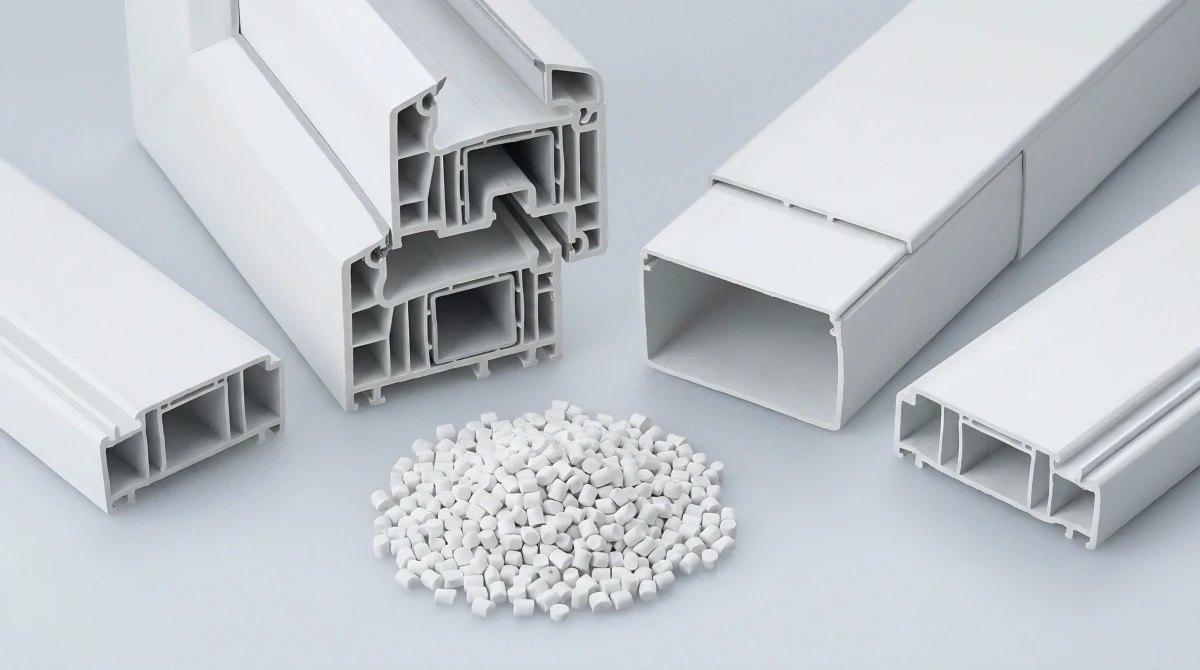
Rigid PVC profiles are stiff and easy to extrude, but their glass transition sets the heat limit, so name service temperature and color with the compound.

What a Rigid PVC Extrusion Compound ContainsRigid PVC, also written PVC-U for unplasticized, is polyvinyl chloride without plasticizer. It is never extruded as bare resin.

Plastic Profile Extrusion Line From Die Lip to Cut Length

A profile die only suggests the shape, and the sizer, puller and saw that follow have to hold the size until the plastic is solid.

The Stations of a Plastic Profile Line From Hopper to SawA typical line has five parts: an extruder, a die with its adapter, sizing and cooling equipment, a puller, and a way to cut the profile to length. The same five appear in a rigid vinyl guide from a PVC compound maker.

Polycarbonate Extruded Profile Properties and What the Datasheet Leaves Out

Read the resin sheet for viscosity, heat and growth, then ask what it leaves out about the profile itself.

What a Polycarbonate Datasheet States for Profile GradesTwo documents are read side by side here. SABIC's datasheet for LEXAN 135 resin describes the highest-viscosity linear polycarbonate powder in its range, and it names profile extrusion as the processing method.

Send the Section Drawing of Your Profile

Send the 2D drawing and the 3D file, with the quantity and the stage of the project. An engineer replies within 1 working day.

The quote form, the mutual NDA and the private folder for your files are on Protolis Atelier, with Profile Extrusion chosen.

Request a Quote