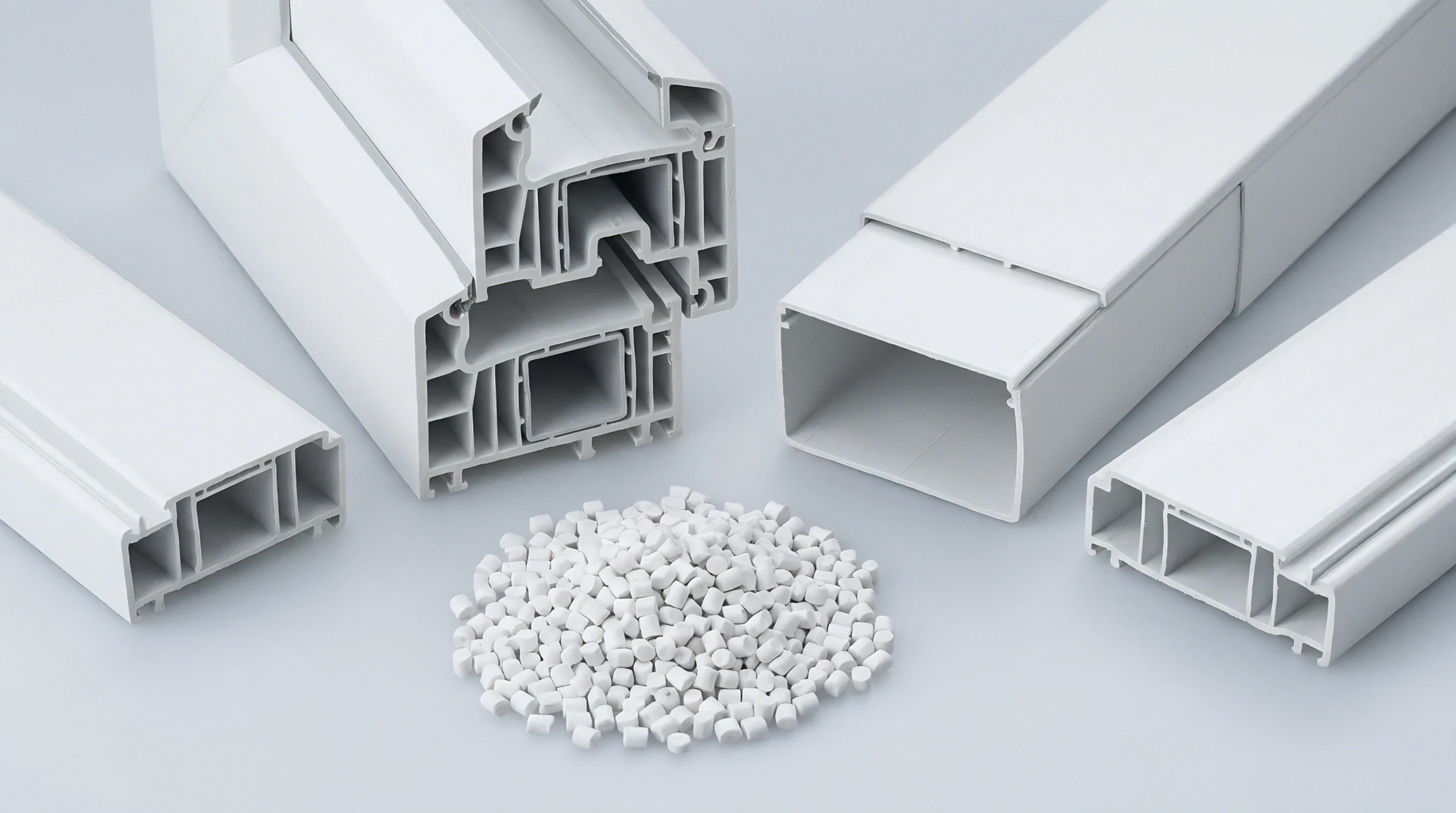
At 23 °C (73 °F), a classical rigid PVC in BASF’s comparison table has a tensile modulus of 2,800 MPa (406 ksi). Heated to 80 °C (176 °F), the same material measures 180 MPa (26 ksi), about one fifteenth of its room-temperature stiffness. Its Vicat softening point sits at 81 °C (178 °F), and NETZSCH places the glass transition of unplasticized PVC between 80 and 90 °C (176 and 194 °F). A rigid PVC profile is stiff, tough and easy to extrude, and all of that holds only while it stays well below the temperature at which its amorphous structure begins to soften.
That narrow thermal margin shapes everything about the material in profile extrusion: the compound a supplier offers, the melt window on the extruder, the cooling after the die, and the way a finished window frame or cable duct behaves on a sunny wall. This article reads the material through published maker data and the ASTM documents that classify it.
What a Rigid PVC Extrusion Compound Contains
Rigid PVC, also written PVC-U for unplasticized, is polyvinyl chloride without plasticizer. It is never extruded as bare resin. GEON’s extrusion guide for rigid vinyl profiles describes its compounds as PVC resin plus the ingredients needed to give useful properties, and ASTM D1784, the classification system for rigid PVC and CPVC compounds, lists the permitted compounding ingredients in nearly the same words:
- thermal stabilizers, which prevent degradation during normal processing;
- lubricants, which give metal release and avoid the stagnation that leads to thermal degradation;
- impact modifiers, for toughness;
- pigments, for color;
- inorganic fillers and other non-PVC resin modifiers, which D1784 also allows.
D1784 covers compounds made of PVC, CPVC or vinyl chloride copolymers containing at least 80 % vinyl chloride. It also sets the physical form: cubes, granules, free-flowing powder blends or compacted powder blends, uniform in size and free of foreign matter. GEON supplies its extrusion grades as cubes, pellets or dry blend.
The form matters for the extruder. GEON’s guide states that extruding dry-blend compounds on a single screw is typically not recommended, because the properties most profiles need will not be fully developed, especially in larger profiles. NETZSCH notes that counter-rotating twin screws are used for compounding or extruding PVC powder, keeping the mechanical stress on a shear-sensitive polymer to a minimum. BASF’s article in Kunststoffe international adds that counter-rotating twin-screw extruders, parallel and conical, are the preferred choice in the PVC industry.
A rigid PVC compound is a recipe of resin, stabilizer, lubricant, modifier and pigment. The datasheet describes the recipe, and the profile inherits it.
Rigid PVC Properties and the Conditions Behind Them
Published property values for rigid PVC come in two kinds: general ranges for the polymer family and values for a specific compound measured on molded test bars. Table 1 sets both side by side, with the test condition each figure carries.
| Property | Value | Condition or method | Source |
|---|---|---|---|
| Glass transition temperature | 80 to 90 °C (176 to 194 °F) | DSC, 10 K/min | NETZSCH |
| Vicat softening temperature | 81 °C (178 °F) | ISO 306, VST/B/50 | BASF |
| Tensile modulus at 23 °C (73 °F) | 2,800 MPa (406 ksi) | ISO 527, molded specimen | BASF |
| Tensile modulus at 80 °C (176 °F) | 180 MPa (26 ksi) | ISO 527, molded specimen | BASF |
| Young’s modulus range | 2,700 to 3,000 MPa (392 to 435 ksi) | family range | NETZSCH |
| Tensile strength at 23 °C (73 °F) | 45 MPa (6.5 ksi) | ISO 527 | BASF |
| Tensile strength at 80 °C (176 °F) | 11 MPa (1.6 ksi) | ISO 527 | BASF |
| Linear thermal expansion | 70 × 10⁻⁶/K (39 × 10⁻⁶/°F) | ISO 11359 | BASF |
| Linear thermal expansion range | 60 to 80 × 10⁻⁶/K (33 to 44 × 10⁻⁶/°F) | family range | NETZSCH |
| Post-shrinkage | 0.9 % | BASF method | BASF |
| Density | 1.38 to 1.55 g/cm3 (0.050 to 0.056 lb/in3) | family range | NETZSCH |
| Thermal conductivity | 0.13 to 0.29 W/(m·K) (0.9 to 2.0 BTU·in/(h·ft2·°F)) | family range | NETZSCH |
| Decomposition | 285 to 315 °C (545 to 599 °F), first stage | HCl formation | NETZSCH |
Two notes travel with the BASF numbers. The stiffness and strength were measured on injection-molded samples to ISO 527, so a profile, with its own orientation and cooling history, may differ. ASTM D1784 states the same principle for its own classification: the values come from standard specimens under specified conditions and are not directly applicable to finished products.
NETZSCH lists the general character behind the numbers: high mechanical stability, stiffness and hardness, good chemical resistance, good electrical insulation, a low tendency to stress cracking, good weatherability and low moisture uptake. It names window profiles, with stabilizers, among the main building uses. GEON adds that compounds can be designed for weatherability, transparency, higher heat resistance or more stiffness, which is why two rigid PVC datasheets can differ while describing the same polymer.
Glass Transition and Heat in a Rigid PVC Profile
PVC-U is amorphous, so it has no melting point to stop at. It passes through the glass transition into a soft, rubbery state, and NETZSCH places that transition at 80 to 90 °C (176 to 194 °F). Vicat softening at 81 °C (178 °F) in BASF’s table falls inside that range. The fall in modulus from 2,800 to 180 MPa between 23 and 80 °C shows what a profile loses as it approaches it.
BASF’s article lists the limits that follow for profiles in service:
- Post-shrinkage once the material has been heated above 60 °C (140 °F); with heat on one side, the result is a permanent curvature of the profile.
- A high coefficient of thermal expansion, which bows a profile when its temperature is uneven.
- A stiffness that drops strongly even at slightly raised temperatures.
- A tendency to creep.
The post-shrinkage test in that article puts a number on the first point. Profiles were held for 16 hours at 50 °C (122 °F), cooled to 23 °C (73 °F) and measured, then taken through the same cycle at higher holding temperatures up to 100 °C (212 °F). The pure PVC profile shrank by up to 1.2 %, which is 12 mm on a 1 m length (0.47 in on 39 in). BASF names dark window frames under strong sun as the case where this shows as permanent curvature.
Thermal expansion adds a reversible movement on top. At 70 × 10⁻⁶/K, a 1 m (39 in) rigid PVC profile that warms by 40 K (72 °F) grows by 2.8 mm (0.11 in). Where the temperature is uneven across the section, BASF notes that this expansion also bows the profile.
Heat sets the limits of rigid PVC well below its processing temperatures. Above about 60 °C (140 °F), a profile can shrink and curve permanently, and near 80 °C (176 °F) it keeps only a fraction of its stiffness.
Stiffening a Profile Without Leaving PVC
One answer to these limits, described by BASF, is co-extrusion with a stiffer polymer. Its Ultradur B4040 G11 HMG HP is a PBT blend with 55 % chopped glass fiber by weight and a melting point of 198 °C (388 °F), lowered from the usual 223 °C (433 °F) for PBT so that both melts can pass through one die in the classical PVC processing window. On molded bars it reaches 20,000 MPa (2,900 ksi) at 23 °C and 4,800 MPa (696 ksi) at 80 °C, and its post-shrinkage is 0.03 %.
The hybrid profiles in BASF’s test held about 18 % PBT and shrank 0.13 % at the highest temperature, against up to 1.2 % for pure PVC. BASF notes that extrusion reaches roughly 70 % of the molded stiffness with a well-designed die, that the PBT layer should not be thinner than 1.5 mm (0.06 in) to limit fiber damage, and that window profiles cut at 45° and welded still weld PVC to PVC.
Melt Window and Extruder Set-Up for Rigid PVC
The thermal stability of PVC in the barrel is a function of time and temperature, GEON’s guide explains. Melt temperatures of at least 188 to 193 °C (370 to 380 °F) are needed to develop the physical properties of typical compounds. Running hotter, at 202 to 210 °C (395 to 410 °F), raises rate and melt uniformity, but run lengths then vary from one day to one week before degradation sets in. Higher temperatures bring degradation sooner.
Teknor Apex publishes a narrower window for its rigid PVC pellets, with melt temperature read by a hand-held pyrometer. Table 2 sets the two makers’ guidance side by side.
| Item | GEON rigid vinyl profiles guide | Teknor Apex rigid PVC pellets guide |
|---|---|---|
| Melt temperature | at least 188 to 193 °C (370 to 380 °F); 202 to 210 °C (395 to 410 °F) for rate | 185 to 196 °C (365 to 385 °F) |
| Barrel and die settings | not stated as a range | barrel 154 to 179 °C (310 to 355 °F); die 174 to 185 °C (345 to 365 °F) |
| Screw length | 24:1 L/D for cubes or pellets; 32:1 vented for dry blend | 20:1 to 24:1 L/D |
| Compression ratio | not stated | 1.8:1 to 2.5:1 |
| Drying | not normally required; some specialty grades 2 h at 71 °C (160 °F) | not required; 49 °C (120 °F) for 2 to 3 h if desired |
| Die | flat plate adequate for about 6 h at low melt temperature; streamlined for long runs | flat plate not suggested; streamlined, low inventory |
| Die and adapter materials | 316, 17-4PH or 420 stainless; no aluminum, brass or copper | 420 stainless or hard chrome |
| Regrind | 10 to 30 %, barrel up to 5.6 °C (10 °F) hotter | up to 20 % |
Both guides treat corrosion as part of the material. NETZSCH notes that PVC forms hydrochloric acid when it decomposes, and that processing equipment should be corrosion resistant. GEON rules out aluminum, brass and copper dies because they react with PVC and describes a gray degradation, called pinking, on new barrels for the first days of use. Teknor asks for the die and its parts to be neutralized at the end of each run to remove residual hydrochloric acid, then treated with a rust inhibitor.
Between screw and die, GEON calls for a breaker plate to stop the melt twisting and leaving swirls in the product, with stainless screen packs, a 20/40 mesh combination being sufficient. It recommends hardened, polished 440C stainless for the plate and chamfered entries and exits, because carbon steel, aluminum or brass and any stagnant corner can degrade the PVC.
GEON’s screw table gives a sense of scale for planning: a 2-1/2 in (63 mm) screw at 50 to 80 lb/h (23 to 36 kg/h), a 3-1/2 in (89 mm) screw at 80 to 300 lb/h (36 to 136 kg/h) and a 4-1/2 in (114 mm) screw at 150 to 500 lb/h (68 to 227 kg/h).
How the Compound Shows in the Finished Profile
Many faults a buyer sees on a rigid PVC profile trace back to fusion, the degree to which the compound particles have melted together. NETZSCH calls the degree of gelation a quality criterion directly linked to impact strength. GEON’s troubleshooting tables connect the two ends:
- brittleness from poor fusion or excessive draw-down, corrected by more screw speed, a hotter melt, finer screens or a re-cut die;
- orange peel or alligator skin from too much fusion, corrected by a cooler melt;
- excessive thermal shrinkage from high residual stress, corrected by less draw-down and a slower cooling rate;
- profile warping from non-uniform or insufficient cooling, or one side holding heat.
Surface faults point to the compound’s other ingredients. Plate-out, a build-up on the die, comes from a compound ingredient sticking to the die metal; lip bleed comes from ingredients exuding at the die exit. GEON lists “check compound selection” among the remedies for both, which places part of the fix with the compound maker rather than the line.
The shrinkage fault links back to heat in service. GEON traces excessive thermal shrinkage to residual stress and prescribes less draw-down and slower cooling, so the line settings affect how far a profile later moves when it is warmed, the behavior BASF measured as post-shrinkage.
ASTM Documents That Classify Rigid PVC Profiles
Three ASTM documents decide how a rigid PVC compound and profile are named and accepted in North America, and a fourth defines the softening test most datasheets quote.
| Document | Covers | What its scope says |
|---|---|---|
| ASTM D1784-25 | rigid PVC and CPVC compounds | classifies by base resin, notched impact, tensile strength, tensile modulus, deflection temperature under load and flammability; similar to ISO 1163-1 and 1163-2 |
| ASTM D3678-26 | rigid PVC interior-profile extrusions | three classes; dimensional stability and extrusion quality; compounds from D1784; recycled rigid PVC permitted under its sections 6 and 7 |
| ASTM D4726-24 | rigid PVC exterior profiles for assembled windows and doors | dimensional stability, weatherability and extrusion quality; color-hold guidelines for white, grey, beige, light brown and dark brown |
| ASTM D1525-17e1 | Vicat softening temperature | compares heat softening of thermoplastics; equivalent to ISO 306 with stated exceptions; not recommended for nonrigid PVC |
D1784 says plainly what it leaves out. Thermal properties, optical properties and weather resistance are to be set by agreement between purchaser and seller, which means a profile that sees sun or heat needs those requirements written into the order. D3678 and D4726 both state that no ISO equivalent is known.
The interior and exterior split matters for color. D4726 provides color-hold guidelines only for white, grey, beige, light brown and dark brown, and states that more colors will be added as guidelines are developed. A darker or more saturated exterior color sits outside those guidelines, and the heat it absorbs pushes the profile toward the post-shrinkage limits above.
What to Ask of a Rigid PVC Compound Before the First Run
A compound for a new profile is chosen on its datasheet and confirmed on the line. The sources above suggest the questions a buyer can put to the compound maker and the extruder together: the D1784 classification or the grade’s own property list, the Vicat or deflection temperature and the test method behind it, the intended service temperature and color, whether the grade is supplied as cube, pellet or dry blend, the regrind level the profile can accept, and the melt window and die materials the maker recommends.
For profiles that will sit in the sun, the useful extra question is post-shrinkage after heating, the property BASF measured and D1784 leaves to agreement. When a new rigid PVC profile needs its compound, die and cooling proven on a first run before volume, low-volume profile extrusion and bridge production are where the grade, the regrind limit and a heat-aging check are agreed before the first lengths are cut.
Sources and Further Reading
- PVC-U, Polyvinyl Chloride (Unplasticized), NETZSCH Analyzing and Testing
- Extending the Limits of PVC, Co-Extrusion of PVC with Modified PBT Blend Improves Profile Mechanics, Kunststoffe international 1/2022, BASF
- GEON Rigid Vinyl Profiles Extrusion Guide, PG0014BC, GEON Performance Solutions
- Processing Guide for Extrusion of Rigid PVC Pellets, Teknor Apex
- ASTM D1784-25, Standard Classification System and Basis for Specification for Rigid PVC Compounds and CPVC Compounds, ASTM International
- ASTM D3678-26, Standard Specification for Rigid PVC Interior-Profile Extrusions, ASTM International
- ASTM D4726-24, Standard Specification for Rigid PVC Exterior-Profile Extrusions Used for Assembled Windows and Doors, ASTM International
- ASTM D1525-17e1, Standard Test Method for Vicat Softening Temperature of Plastics, ASTM International