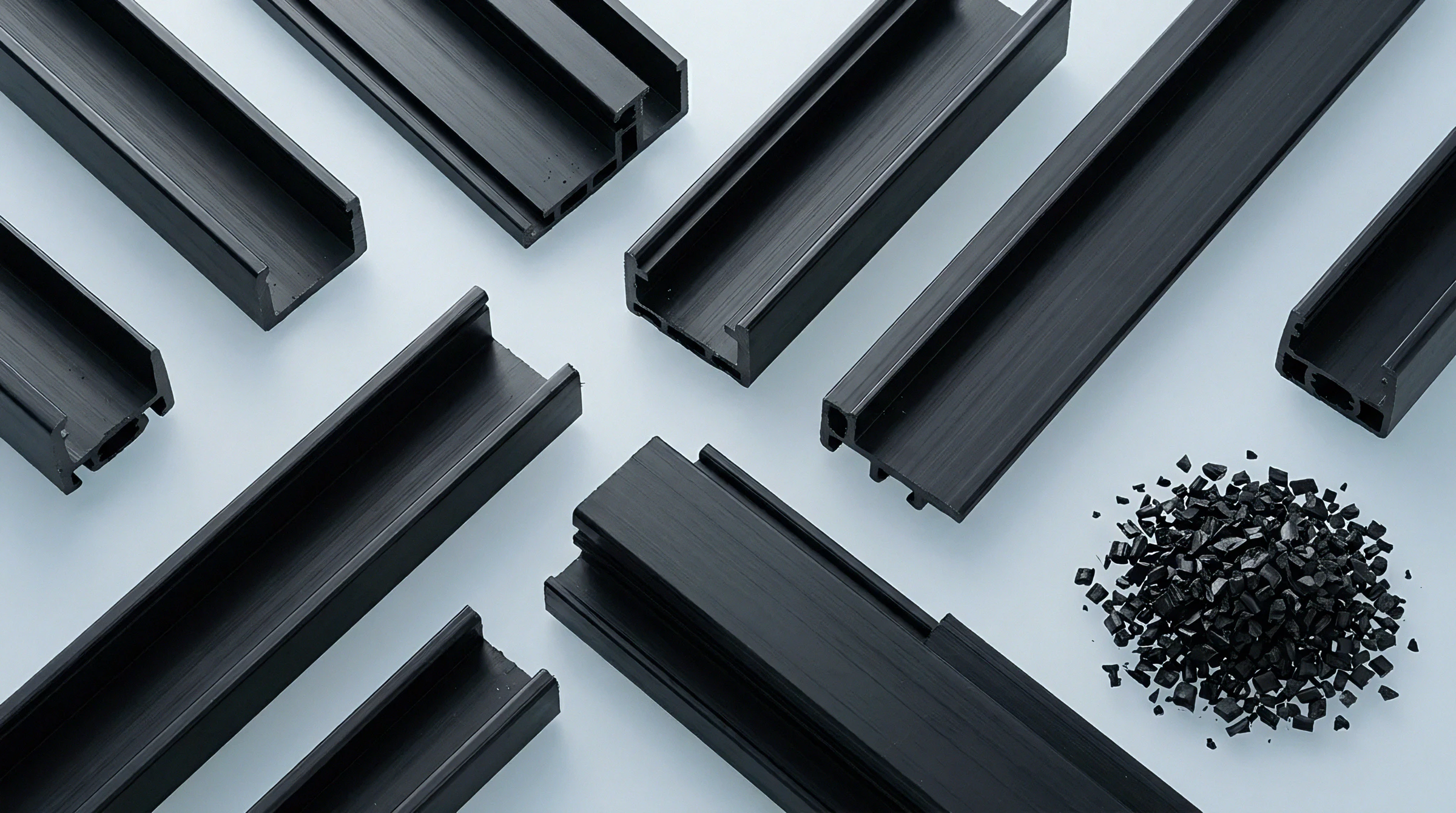
A 2.5 in. (64 mm) extruder running 100 to 125 lb/hr (45 to 57 kg/h) delivers, in meters per minute, about 3 to 3.8 m/min of a profile that weighs 0.25 kg per meter, and about 0.8 to 0.9 m/min of one that weighs 1 kg per meter. One line of arithmetic gives the relation, kilograms per hour divided by kilograms per meter and by 60, and it is the first thing that sizes a run. The output figures come from a trade-journal table on profile die design, and the conversion comes from an OEE guide for pipe and profile lines.
A run is more than the steady-state hours that arithmetic gives. It begins with a die and a sizing set that were made for one resin, it passes through a trial that makes scrap until the profile is in tolerance, and it ends with a die that has to be cleaned. The sections below follow those pieces and the figures that published sources attach to each, with a worked example for a quantity in the low thousands of meters.
What a Plastic Profile Run Is Made Of
Four parts make a run: the tooling set, the start-up, the steady production and the changeover at the end. Each has its own tool, its own time and its own scrap, and a buyer who plans a quantity needs to ask about all four.
| Part | What happens | Published guidance | Source |
|---|---|---|---|
| Tooling set | die, sizing or calibration tooling, puller settings | a die designed for PP cannot be used for other polymers | Plastics Technology, profile die design |
| Start-up | line brought to size and surface | scrap is everything made after a start or die change until diameter, wall and surface are in tolerance | OEE guide for pipe and profile lines |
| Steady production | constant puller speed, size held by sizing tooling | line speed up to 20 % possible for polyolefins, at the risk of instability | Plastics Technology, retooling article |
| Changeover | cleaning, purge, die care | a PVC die is neutralized of residual hydrochloric acid at the end of a run | Teknor Apex processing guide |
The tooling set belongs to one resin, the start-up makes scrap, the steady hours are arithmetic, and the changeover has its own procedure. Each of the four needs a line on the plan.
Why the Tooling Set Is Tied to One Resin
Plastics Technology’s profile die guidance says that every thermoplastic has its own specific heat and so its own drawdown ratio, which explains why a die designed for PP cannot be used for other polymers. A Plastics Technology article on retooling adds an example from pipe and tube: a very low-drawdown material such as rigid PVC cannot be reduced to a smaller size from the same die, while a more viscous TPE can be drawn down by 50 percent or more. Anyone who might change resin between a pilot and a production run should plan on a different die, not a different setting.
Output, Meters per Hour and the Hours a Quantity Takes
The OEE guide gives the relation that links the two rates: kilograms per hour equals meters per minute times 60 times kilograms per meter. It adds that performance is best measured in meters at the target meter weight, because a profile that runs heavy can look like full speed in kilograms per hour while the line makes fewer meters.
| Profile weight (kg/m) | At 45 kg/h (m/min) | At 57 kg/h (m/min) |
|---|---|---|
| 0.10 | 7.6 | 9.5 |
| 0.25 | 3.0 | 3.8 |
| 0.50 | 1.5 | 1.9 |
| 1.00 | 0.8 | 0.9 |
The two rates, 45 and 57 kg/h, are the 100 and 125 lb/hr of the die design table’s 2.5 in. extruder. A larger extruder or a lower-weight profile changes the numbers, and a real line is rated by its own maker. The table shows the shape of the relation: a light profile runs fast and a heavy one runs slowly, and the extruder is the same.
Hours for a Quantity
The profile weight sets how many hours of steady running a quantity needs. For a profile weighing 0.25 kg per meter, three quantities give the following steady running at the same two extruder rates.
| Quantity (m) | Metal (kg) | Hours at 57 kg/h | Hours at 45 kg/h |
|---|---|---|---|
| 500 | 125 | 2.2 | 2.8 |
| 2,000 | 500 | 8.8 | 11.0 |
| 10,000 | 2,500 | 44.1 | 55.1 |
These are not forecasts for any plant. They show that a quantity in the hundreds of meters fills part of one shift, so that start-up, trial and changeover decide the schedule, and that a quantity of 10,000 m takes 44 to 55 hours of steady running, which is days of one line. The OEE guide notes that a die change takes the line down for a long time and ends in scrap. For a short run, that time and that scrap are a large share of the whole.
Start-Up, the Die Trial and Scrap
The OEE guide defines start-up scrap as pipe or profile made after a start or die change until diameter, wall thickness and surface are in tolerance, and it treats it as a quality loss counted in meters and kilograms. It also points out that pipe and profile lines are continuous: when the haul-off, saw or stacker stops, the extruder often keeps running because a restart is long, and the loss shows up in the regrind bin and not in the stop log.
What the Trial Is Looking For
A rigid vinyl processing guide lists the symptoms that a start-up shows and the usual cause of each. Warp points at uneven cooling or equipment misalignment. Dimensional surging points at puller speed, vacuum or feed variation. Excessive thermal shrinkage points at high residual stress from too much drawdown or too fast cooling. Die lines point at a nicked die approach or plate out. The same guide gives melt temperatures that explain the length of a run as well: at least 188 to 193 °C (370 to 380 °F) to develop the physical properties of typical PVC sheet compounds, and 202 to 210 °C (395 to 410 °F) when output and melt uniformity matter more, with run lengths at the higher temperatures varying from one day to one week before degradation shows.
A new barrel adds to the first run. The guide notes that PVC degradation at the metal surface of a new barrel, sometimes called pinking even though it is gray, often occurs for up to a few days.
- Warp, twist and bow: sizing, cooling and alignment.
- Size surging: puller speed, vacuum and feed.
- Surface lines and dull surface: die, melt temperature and fusion.
- Brittleness: fusion and drawdown.
The pairs come from the guide’s own table, and they are written for its own compounds. A different material has different cures.
Drying, Feed and Water
Two supply questions sit under every start-up. Moisture is the first. Newey notes that hygroscopic materials absorb water from the air, that moisture in the melt lowers viscosity and causes surface imperfections and size variation, and that such materials are dried on a continuous basis through a dehumidifier, with polyamides fed on a closed loop because they absorb water so quickly. A Teknor Apex guide for rigid PVC pellets says drying is typically not required, with 120 °F (49 °C) for 2 to 3 hours if desired. The second question is cooling water. Newey states that most lines need a recirculating water system with a chiller, since the process works on heat that has to be taken away to run over long periods. A line without enough chilling capacity changes its cooling rate through the day, which is what shows up as drift in size.
The first hour of a run is spent on things the drawing never shows: dry material, a stable water temperature, a die at temperature and a puller at speed.
What the Published Sources Do Not Say About a Short Run
Published sources give no typical figure for start-up scrap as a share of a short run, no typical number of trials for a new profile die, and no lead time for plastic profile tooling. What the OEE guide offers is a definition of start-up scrap and a way to count it, and the die design articles describe how a die is built, but none of them prints a percentage or a number of days a buyer could plan from.
That gap is itself useful. It means the answers come from the extruder, and the buyer’s job is to ask the right questions before the die is cut: which resin the die is for, how many trials the extruder expects, who approves the first good length and by what measurement, and what the extruder will hold the scrap to. A supplier who can answer those from its own records is a better choice for a pilot than one who quotes a single number.
- Ask for the die lead time in writing, as a date counted from approved drawings.
- Ask how many trial runs are planned and whether each is a separate line booking.
- Ask how the first good length is measured and who signs it off.
Sizing Tooling and the Short Run
How the profile is sized sets how long the tooling takes to get right. Plastics Technology describes air-rack sizing as simple tooling and now mostly confined to prototyping and short runs, because the size follows the cooling set point and changes if that point drifts. Calibration tooling with vacuum ports is more elaborate and builds in more control, and the same article says it pays back in higher profile quality and less scrap. Typical profile walls run from 1 to 3 mm in that article, and hollow profiles need wet calibration, often with differential vacuum.
For a run in the hundreds of meters, the choice reads as a tradeoff between how fast the tooling can be built and how well it holds the size. An air rack can be set up quickly and will drift. A calibrator takes longer to make and holds. If a specific tolerance is needed across a run, the buyer asks which of the two the extruder plans to use, and asks for the sizing method to be named in the quote. Before any die is cut, a short length for a fit check is sometimes 3D printed from the profile drawing, which can show whether the section clips onto its partner, though it says nothing about how the real extrudate will draw down.
Putting the Pieces Together for 2,000 Meters
Take the 0.25 kg per meter profile from Table 3 and an order of 2,000 m, which is 500 kg of finished profile. Steady running at the extruder rates above is 8.8 to 11 hours. On top of that sit the pieces the sources describe but do not size: a die and sizing set made for the resin, a start-up that scraps material until the profile is in tolerance, and a changeover at the end.
If the extruder grinds start-up scrap and blends it back at a share inside the 10 to 30 percent that the GEON guide gives for rigid PVC, the material is not lost, but the quantity of virgin compound that has to be bought for a given number of good meters rises with the scrap. An assumed start-up scrap of 50 kg, for instance, is 10 percent of the order by weight and 200 m of the profile at 0.25 kg/m. The figure is an illustration chosen for round arithmetic, not a published number, and the real one has to come from the extruder.
The plan that follows has four lines: one die, one sizing method, one resin lot ordered with a margin for start-up, and one set of agreed measurements for the first good length.
Regrind, Purge and Die Care at the End of a Run
Rigid PVC regrind can be ground and blended back into virgin material at 10 to 30 percent, according to the GEON guide, with larger amounts possible if the surface is still acceptable. It adds that barrel temperatures may need to go up by as much as 10 °F (about 6 °C) to compensate for the higher work level of regrind, and its troubleshooting table lists regrind among the causes of edge tear and of surface defects. For a short run the practical point is that start-up scrap becomes part of the next hour’s feed, so the first minutes of a run feed the quality of the rest.
Changing Material on the Same Line
Changing resin takes a purge. An extrusion trade society’s note on purging says the sequence depends on the pair of resins, that some pairs should never follow one another, with PVC and acetal named as reacting violently together, and that high temperature resins can freeze in the system if cooled too fast. A rigid PVC processing guide directs the use of a PVC purging compound, and says that at the end of a production run, the die and its parts should be neutralized to remove residual hydrochloric acid and then treated. Both sources describe work that takes time and material, which belongs in the schedule of any run that follows another material on the same line.
Inspection Along a Run
Dimension is held by three things, Mike Newey writes: a steady melt rate, a controlled cooling rate and a constant draw-off. Where a line has laser or ultrasonic gauges, they feed back to the extruder or the haul-off to hold size, and where it does not, the check is a person with a gauge at intervals. The OEE guide counts quality in meters, with the scrap weighed in kilograms, and notes that much of it is reground and fed back.
A buyer can ask the extruder to state four things before a run:
- Which dimensions are checked, how often and with which gauge, and whether a gauge is on the line.
- How start-up scrap is counted and what it is allowed to be before the first good meter.
- Whether regrind is used, at what share, and from which lot.
- What happens at the end of the run to the die and the sizing tooling.
When the Next Tool Pays
The published guidance gives three situations in which a run needs a new tool and not a new setting. A different resin needs a different die, a different size usually needs a different die and sizer, and a much higher production rate needs calibration tooling in place of an air rack. Output arithmetic points to a fourth, though no source states it: a quantity large enough that the weeks of running justify tooling that holds size more tightly.
For a quantity in the hundreds of meters the first run is the tooling and the trial, and for one in the thousands it is days of line time. A program that needs profile samples and a pilot quantity before the production tooling is committed can use low-volume profile extrusion as bridge production, with the resin, the sizing method and the scrap allowance agreed before the die is cut.
Sources and Further Reading
- Plastics Technology, Tooling Know-How: Five Tips on Profile Die Design
- Plastics Technology, How to Size and Calibrate Profile Parts
- Plastics Technology, When to Adapt, When to Retool?
- Fabrico, OEE for Pipe and Profile Extrusion: Die Changes and Start-Up Scrap
- GEON Performance Materials, PG0014BC GEON Rigid Vinyl Profiles Extrusion Guide
- Teknor Apex, Rigid PVC Extrusion processing guide
- Mike Newey, Getting critical on extrusion
- SPE Extrusion Division, Purging Extruder Systems, Vol. 33 No. 1, 2006