Edition

An edition is the dated version of a standard, such as EN 12020-2:2022, and the edition named on a drawing decides which scope and limits apply.

Every Edition article of the Profile Extrusion Resources, newest first, each written from published standards, research and makers’ data.

Meaning

An edition is the dated version of a standard, such as EN 12020-2:2022, and the edition named on a drawing decides which scope and limits apply.

Why the Year Matters

Standards change between editions in ways that move a profile in or out of scope. EN 12020-2:2016 set precision profiles apart by architectural use, stricter visible surfaces, a 350 mm (13.8 in) circle and closer tolerances; the 2022 edition sets them apart by mostly uniform walls, a weight of no more than 10 kg/m (6.7 lb/ft) and a wall ratio of no more than 3.5. ISO 7599:2018 replaced the 2010 edition, which BSI lists as withdrawn on 23 February 2018, and changed its title and its eddy current calibration annex.
Read More

Current Editions

ANSI H35.2-2017 was approved on 12 May 2017 as a revision of the 2013 edition and carried an errata issue that December. DIN 16941:2012-11 is the current edition of the German general tolerances for extruded thermoplastic profiles. The PCI comparison of March 2021 sets Qualicoat classes beside FGIA AAMA 2603-21, 2604-21 and 2605-20, while the Sherwin-Williams guide specification cites the 2022 editions, and Qualicoat’s 26th edition is valid from 1 January 2026.

National Numbers

European standards appear under national covers, BS EN, DIN EN or STN EN, with the same text, and each cover records which national edition it withdrew.

Drawing Callout

A complete reference names the standard, the part and the year. A reference without a year points to whatever edition is current when it is read.
Anodized Film Thickness and Color Tolerance on Extruded Profiles

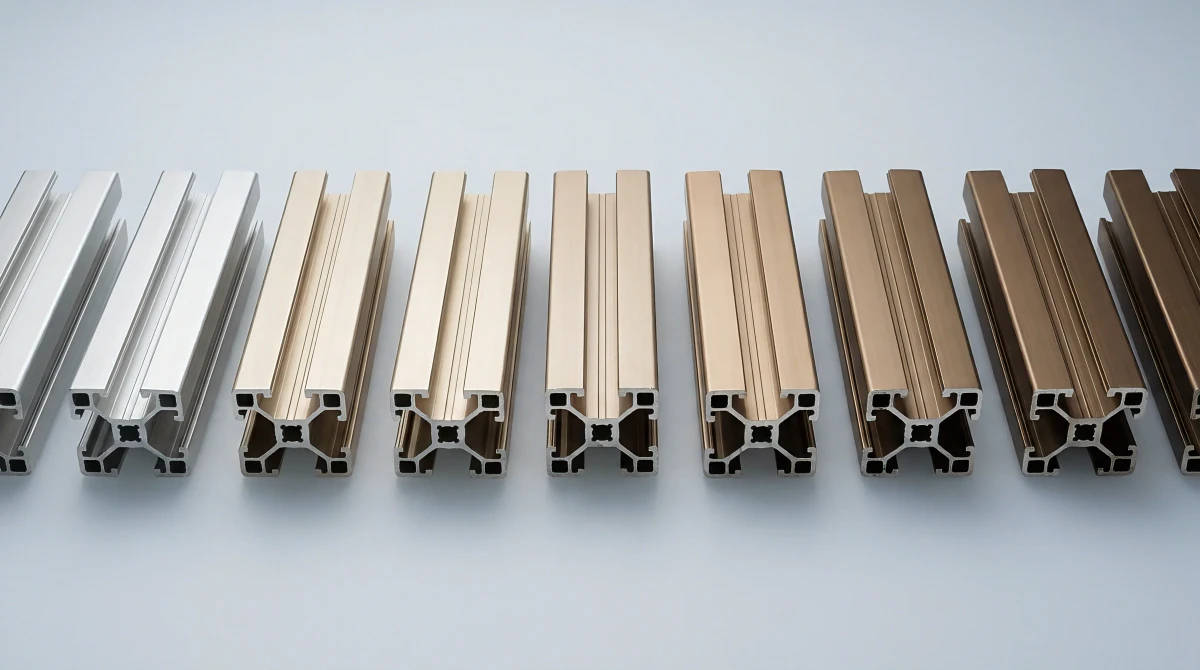
Specify anodic film as an ISO 7599 class on marked faces, and agree color against limit samples before the first lot is anodized.

How Anodized Film Thickness Is Specified and AcceptedISO 7599:2018, published in Europe as EN ISO 7599:2018 and in Britain as BS EN ISO 7599:2018, lays down the method. Its contents run from the information the customer supplies to the anodizer, through coating thickness, sealing, appearance and color, to a normative annex on interpreting average and local thickness.

Qualicoat and AAMA 2603 to 2605 Coating Specifications for Aluminum Extrusions

Name the Qualicoat class or AAMA tier on the drawing, then fix the approved sample, channel thickness and machining rules that neither standard settles.

What Qualicoat and AAMA 2603, 2604 and 2605 CoverQualicoat is a quality label for coatings on aluminum for architectural use. Its 26th edition, introduced in the document QCT-INTRO-26 valid from 1 January 2026, splits the specifications into three volumes: one for coaters, one for makers of chemical pretreatments and one for powder makers.

EN 755-9 and EN 12020-2 Scope and Editions for Aluminum Extruded Profiles

Name EN 755-9 or EN 12020-2 with its year, because scope, alloys and limits differ by standard and edition.

What EN 755-9 and EN 12020-2 Each CoverEN 755-9 is part 9 of the EN 755 series for extruded rod and bar, tube and profiles. BSI describes BS EN 755-9:2016 as specifying the tolerances on dimensions and form for aluminum and aluminum alloy profiles with a cross-section contained within a circumscribing circle not greater than 800 mm.

Straightness, Twist and Flatness Tolerance of Aluminum Extrusions

Form limits scale with length and width, so work them out for the real length before accepting a drawing.

The Straightness Limit and Its FormulaTable 11.6 of Aluminum Standards and Data, in the May 2009 reprint, gives the allowable deviation D from straight in inches. For profiles the limit is a factor multiplied by the measured length in feet, and it applies in total length or in any measured segment of one foot or more of the total length.

DIN 16941 General Tolerances for Extruded Plastic Profiles

Cite the edition and the series on the drawing, then add what the general tolerances leave open.

What DIN 16941 CoversThe current edition is DIN 16941:2012-11, titled Thermoplastics extruded profiles, General tolerances of size, form and orientation, with the German title Extrudierte Profile aus thermoplastischen Kunststoffen, Allgemeintoleranzen für Maße, Form und Lage. It is published in German, with an English translation sold separately, and it replaces DIN 16941:1986-05.

ASTM B221 for Extruded Aluminum Profiles Read for the Buyer

The specification certifies alloy, temper and tensile behavior, so the drawing still has to carry geometry, units and thickness.

What ASTM B221 CoversASTM's catalog page for B221-21, last updated October 29, 2021, describes the standard as a specification for aluminum and aluminum-alloy extruded bars, rods, wire, profiles and tubes. It covers the alloys and tempers listed in its Table 2 and requires the products to be made by hot extrusion or a similar process.

ANSI H35.2 Standard Tolerances for Aluminum Extrusions

Name the edition and the class on the drawing, because the standard column governs when nothing is written.

What ANSI H35.2 Covers and How to Cite ItThe title is American National Standard Dimensional Tolerances for Aluminum Mill Products, and the Aluminum Association is its secretariat. Opened for this piece was ANSI H35.2-2017, approved May 12, 2017 as a revision of the 2013 edition, in the December 2017 errata issue.

Send the Section Drawing of Your Profile

Send the 2D drawing and the 3D file, with the quantity and the stage of the project. An engineer replies within 1 working day.

The quote form, the mutual NDA and the private folder for your files are on Protolis Atelier, with Profile Extrusion chosen.

Request a Quote