6063

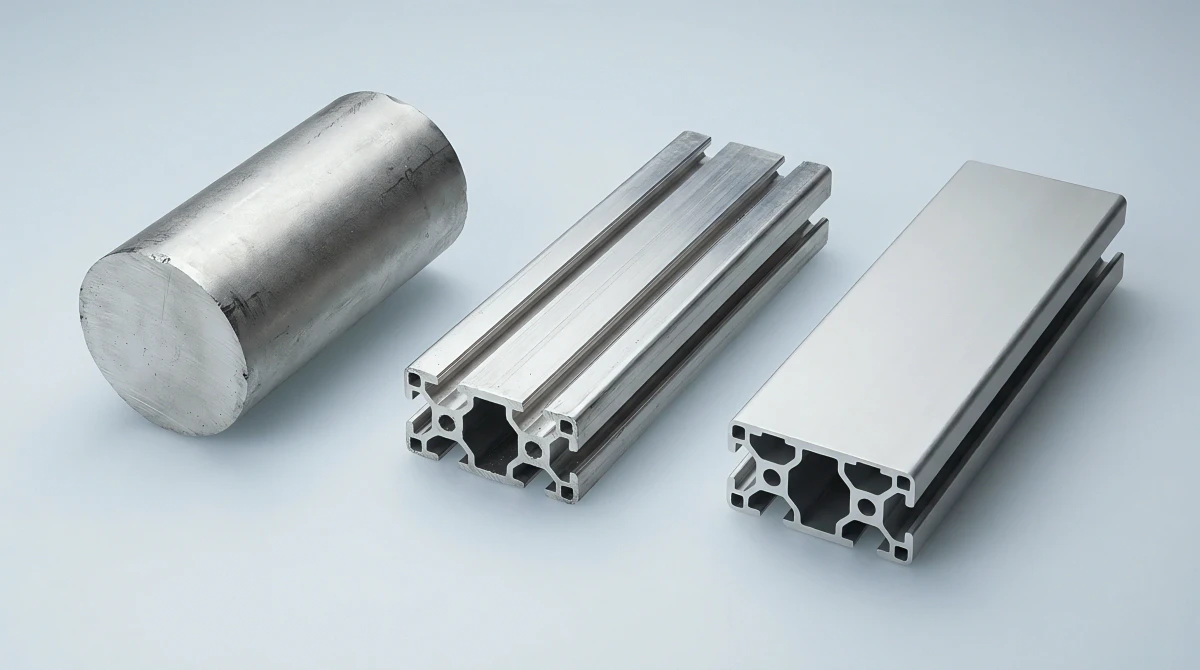
Alloy 6063 is a soft, forgiving aluminum-magnesium-silicon extrusion grade, designated EN AW-6063 or AlMg0.7Si, chosen mostly for anodized profiles.

Every 6063 article of the Profile Extrusion Resources, newest first, each written from published standards, research and makers’ data.

Meaning

Alloy 6063 is a soft, forgiving aluminum-magnesium-silicon extrusion grade, designated EN AW-6063 or AlMg0.7Si, chosen mostly for anodized profiles. Its strength is set more by temper and wall thickness than by the alloy name. It sits at the low-strength, high-finish end of the 6000 series. Hydro notes that it has been increasingly replaced by 6060 where surface finish leads.

Composition

Hydro lists the EN 573-3 limits by weight. The sheet allows 0.20 to 0.60 % silicon and 0.45 to 0.90 % magnesium. Iron may reach 0.35 %, while each of copper, manganese, chromium, zinc and titanium stops at 0.10 %. Hydro adds that its internal limits are tighter, with variants made to deliver T6 and T66. A structural grade such as 6082 carries roughly twice the silicon and an added manganese range.
Read More

Guaranteed Strength

Hydro’s minimums come from EN 755-2 and depend on temper and wall. Up to 10 mm (0.39 in), T5 is guaranteed 130 MPa (18.9 ksi) yield and T6 is guaranteed 170 MPa (24.7 ksi). From 10 to 25 mm, T5 drops to 110 MPa (16.0 ksi). T66 reaches 200 MPa (29.0 ksi) in thin walls. The bending-quality T64 trades yield, at 120 MPa (17.4 ksi), for 12 % elongation. Elongation in T6 is 8 %.

North American Limits

The Aluminum Association’s table splits the bands at other thicknesses. Its 6063-T5 limits up to 12.7 mm (0.500 in) are 152 MPa (22.0 ksi) tensile and 110 MPa (16.0 ksi) yield. For 6063-T6 it gives 207 MPa (30.0 ksi) tensile and 172 MPa (25.0 ksi) yield. Its T5 band ends at 12.7 mm, against 10 mm in the European table. An 11 mm wall is thin in one system and thick in the other. A producer temper, 6063-T52, adds a ceiling of 207 MPa to its tensile range.

Physical Data

Hydro gives typical values at 20 °C (68 °F). Density is 2.70 g/cm³ (0.0975 lb/in³), and the modulus of elasticity is 69 GPa (10.0 Msi). The melting range runs from 615 to 655 °C (1,139 to 1,211 °F). Thermal conductivity in T6 is 201 W/m·K (116 BTU/h·ft·°F), higher than the 172 W/m·K of 6082-T6. That is why heat-sinks appear among its applications. Linear expansion is 23.5 × 10⁻⁶ /K, so a 6 m length grows about 1.4 mm (0.055 in) per 10 °C.

Press and Oven

An Alliance process sheet sets a minimum press exit of 499 °C (930 °F) for 6063, read at the platen. The quench then keeps the alloying elements dissolved, ready for the oven. Hydro plots aging curves at 165, 175, 185 and 195 °C (329 to 383 °F) for an air-quenched 200 × 3 mm profile. Hydro prints curves rather than a recipe, so the aging hours come from the extruder’s own approved procedure.

Next to 6060

Alloy 6060 is the usual alternative when the face matters most. Hydro grades its surface finish 5, against 4 for 6063, and its tensile strength 1 against 2. In T6 up to 5 mm (0.20 in), 6060 is guaranteed 150 MPa (21.8 ksi) yield and 190 MPa (27.6 ksi) tensile. The 6063 band runs to 10 mm and gives 170 and 215 MPa (24.7 and 31.2 ksi). The 6060 sheet also holds iron to a narrower window of 0.10 to 0.30 %.

Workshop Grades

Hydro’s relative grading, with 5 as the top grade, gives 6063 a 5 for decorative anodizing, corrosion resistance, cold forming and weldability. Machinability is graded 3 and surface finish 4. The AEC manual names 6063 and 3003 as softer alloys that machine best with large rake angles and light cuts. For a part that is anodized and seen, the choice between 6063 and 6060 comes down to strength against surface.

Order Line

An order for 6063 names the alloy with its standard, such as EN AW-6063 to EN 755-2. Under ASTM practice the UNS number is A96063. The temper follows, usually T5 or T6, with T66 where the wall allows and T64 for bending. The thickest wall in millimeters fixes the band on the certificate. The finish is named too, since anodizing is the usual reason to choose this alloy.
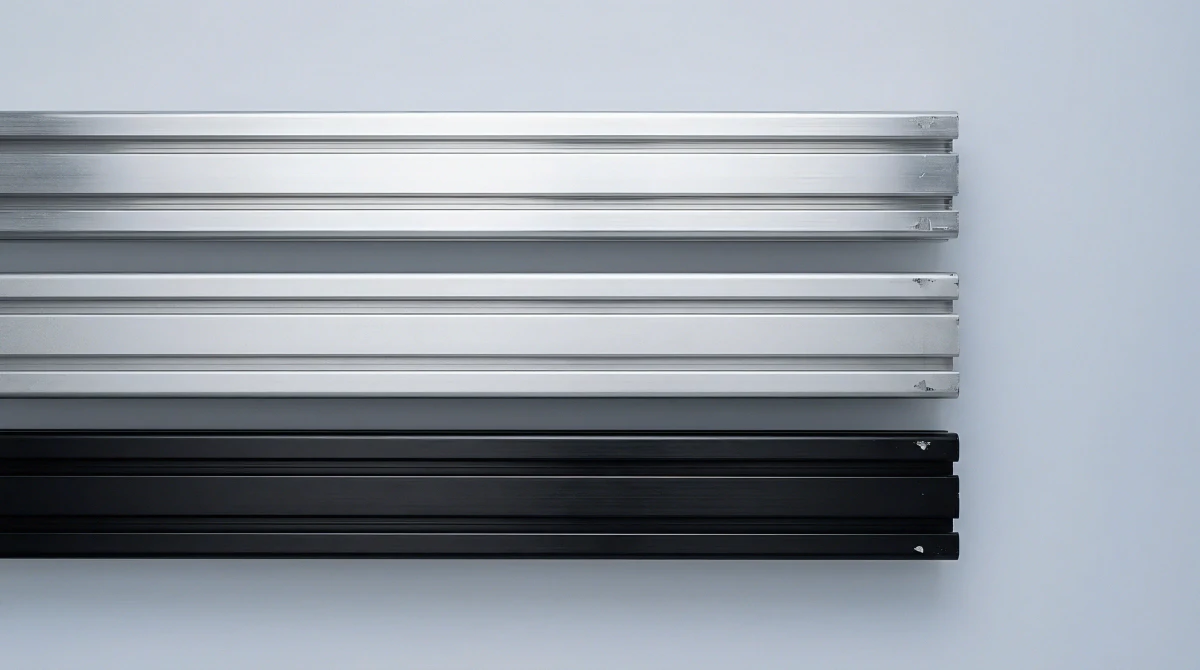
Anodizing Extruded Aluminum Profiles Step by Step

Anodizing an extrusion is a line of tanks, and the rack, etch, bath, color and seal each leave their own mark on the profile.

The Anodizing Line From Rack to SealHydro's anodizing brochure for extruded profiles lays out the line in the order the profiles travel. The Aluminum Anodizers Council groups the same work into five stages: cleaning, pretreatment, anodizing, coloring and sealing.

Anodized Film Thickness and Color Tolerance on Extruded Profiles

Specify anodic film as an ISO 7599 class on marked faces, and agree color against limit samples before the first lot is anodized.

How Anodized Film Thickness Is Specified and AcceptedISO 7599:2018, published in Europe as EN ISO 7599:2018 and in Britain as BS EN ISO 7599:2018, lays down the method. Its contents run from the information the customer supplies to the anodizer, through coating thickness, sealing, appearance and color, to a normative annex on interpreting average and local thickness.

EN 755-9 and EN 12020-2 Scope and Editions for Aluminum Extruded Profiles

Name EN 755-9 or EN 12020-2 with its year, because scope, alloys and limits differ by standard and edition.

What EN 755-9 and EN 12020-2 Each CoverEN 755-9 is part 9 of the EN 755 series for extruded rod and bar, tube and profiles. BSI describes BS EN 755-9:2016 as specifying the tolerances on dimensions and form for aluminum and aluminum alloy profiles with a cross-section contained within a circumscribing circle not greater than 800 mm.

How Much of an Aluminum Billet Becomes Shipped Profile

Order weight, butt, stretcher ends and rejects decide how many billets a small aluminum extrusion run takes and what the buyer receives.

The Yield Stack From Billet to Shipped LengthA billet is heated, pushed through a die, quenched, stretched, sawn and aged. Metal leaves the stream at three points, and each has a figure in the published sources.

Cutting and Machining Extruded Aluminum Lengths

A press saw makes bars into shippable lengths, and a precision saw with the right blade, clamps and datums makes the length the drawing asks for.

The Order of Operations From Bar to Cut LengthCutting comes first in almost any fabrication plan, with deburring and then drilling, punching or machining after it. A burr left from the cut sits where the clamp has to hold the piece for the next step, so the order carries weight.

Aluminum Extrusion Process From Billet to Aged Profile

The press pushes a softened billet through a die, and the quench, stretch and oven that follow decide whether the bar is straight and strong.

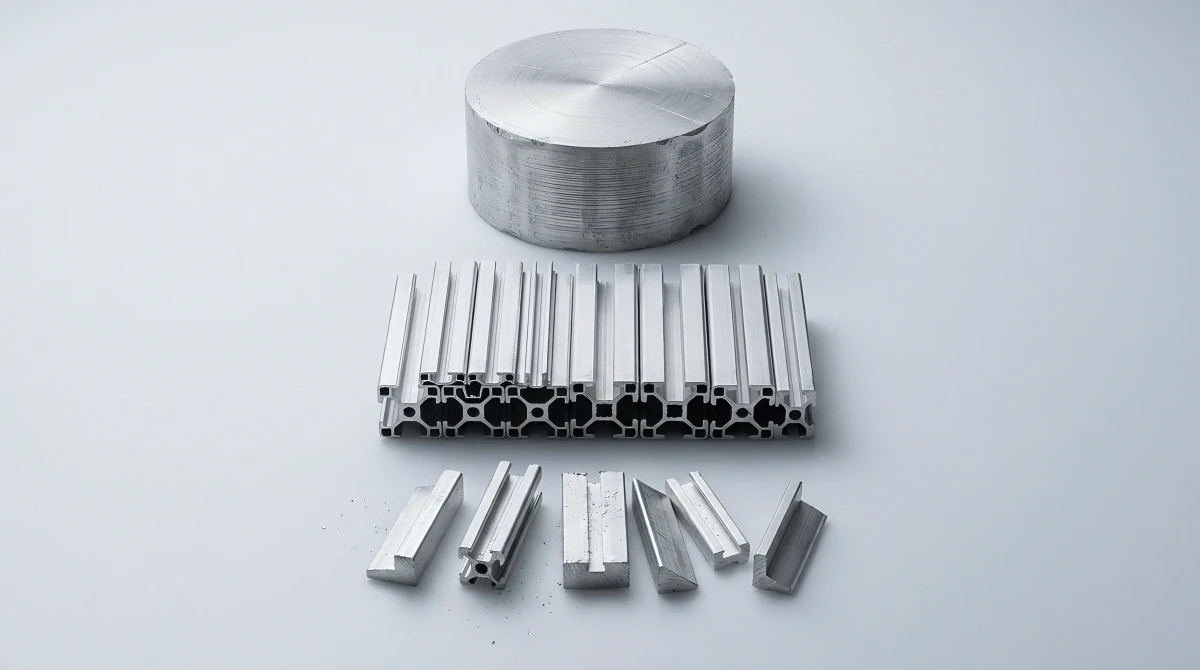
The Steps of Aluminum Extrusion in the Order the Metal Meets ThemSeven operations turn a cast billet into a profile ready for finishing. A billet is a solid cylinder of cast aluminum, and it never melts on the way.

ASTM B221 for Extruded Aluminum Profiles Read for the Buyer

The specification certifies alloy, temper and tensile behavior, so the drawing still has to carry geometry, units and thickness.

What ASTM B221 CoversASTM's catalog page for B221-21, last updated October 29, 2021, describes the standard as a specification for aluminum and aluminum-alloy extruded bars, rods, wire, profiles and tubes. It covers the alloys and tempers listed in its Table 2 and requires the products to be made by hot extrusion or a similar process.

6063 Aluminum Extrusion Properties in T5 and T6

Read the temper, the thickest wall and the word minimum before trusting any strength figure for this alloy.

What EN AW-6063 Guarantees in T4, T5, T6 and T66Hydro's datasheet for EN AW-6063 (alloy designation AlMg0.7Si) lists minimum mechanical properties taken from EN 755-2:2016 for extruded profile. The values are minimums, and each row is tied to a wall thickness band.

Send the Section Drawing of Your Profile

Send the 2D drawing and the 3D file, with the quantity and the stage of the project. An engineer replies within 1 working day.

The quote form, the mutual NDA and the private folder for your files are on Protolis Atelier, with Profile Extrusion chosen.

Request a Quote